Resisting Sexism, Homophobia and Transphobia
Editor’s note:
In our last issue David Gilbert wrote “An Open Letter to Movement Men About Sexism”. We asked people to send in material about this important issue. We are reprinting David’s letter and beginning a necessary discussion (again – 4sm first raised the issue of patriarchy and sexism a few years ago). We invite readers – men and women, to send in their thoughts and experiences. As we often say, “Freedom is a Constant Struggle”, and that includes contradictions within our own attitudes and understanding and within our collectives and organizations.
An Open Letter to Movement Men About Sexism
BY DAVID GILBERT
Dear Brothers,
There is no way we can be revolutionaries, no way we can stand with humanity for liberation, without actively combating male supremacy. That imperative requires both a political program against patriarchy and concerted struggle against sexism within ourselves. We all grew up in this society so, even with our passionate ideals, problems with ego, racism, classism, sexism, homophobia, transphobia and ableism within ourselves are inevitable. What is inexcusable is to fail to engage in sincere and open-hearted efforts to change.
It has been extremely upsetting to have heard, even with my limited contact with the outside activist communities, of several incidents of sexual assault and then – to add bitter insult to monstrous injury – the frequent failures to have a process for holding perpetrators accountable and for setting unmistakable standards for activist communities. We are fighting for a world without sexual assault, abuse, coercion – how can we allow that to continue within our ranks?
Men’s sense of entitlement to women’s bodies, the violations and the denial of self-determination involved, parallels the ideology and practice of imperialism. Each attack does vicious harm to a sister, while the reality of sexual assault is the ferocious spearhead of the much broader offensive against women’s fully active and assertive role in our movements, which we sorely need for the colossal challenges we face. Also, our failure to develop a process to stop such crimes is corrosive to our own humanity.
In the 1960s we started from nowhere in terms of dealing with patriarchy – and nowhere meant the continued dominance of male supremacy. Then, women’s collective leadership around feminism and anti-imperialism, although often faced with reactionary resistance from men, won major advances.
As dramatic as those changes were, they of course weren’t nearly enough; on top of that we have evidently failed in our responsibility to pass on hard-won lessons to the post-Seattle, 1999, generation of activists. If we don’t do better on this, we leave a lethal hole in the heart of our movement.
In my own experience, the most fruitful response to women’s liberation came in the form of Men Against Sexism groups – if they weren’t just a place to talk about our feelings but if we also consciously grappled with sexism, checked-in with and sought guidance from feminists, and took on solidarity work such as childcare and/or educating other men and boys.
Today, we may want and need additional formats, for example, to fight the oppression of those who are gender nonconforming. Whatever the forms, concerted struggle against patriarchy, with male supremacy as a central axis, is absolutely necessary.
Male supremacy is extremely deep-seated in history and in society. Change doesn’t come easily and won’t always be comfortable. As difficult as it may seem, advances on this front can stop the brutality of men’s assaults on women in our communities and help create a welcoming climate for their full participation. We can’t have a real movement, we can’t possibly be successful, without the invaluable contributions and leadership women can provide. Such advances can also make us men more whole, more loving human beings.
White supremacy, male supremacy, homophobia, transphobia, class rule, and imperialism are powerful pillars of oppression. We have to dismantle them all to clear the ground to build the more humane and sustainable world that is so urgently needed.
One love,
David Gilbert
(anti-imperialist political prisoner)
“Recent events in India (the group rape and murder of the Indian woman on a bus) show what women are really up against in society as it now is run (for profit only). These conditions for women exist all over the world, exacerbated by war. Insofar as sexism exists in progressive circles, it’s a pale reflection of the whole weight of sexist social norms of class-divided society. As long as real power is in the hands of only a few (and those are almost all white men), as long as human beings cannot control their own lives in even the most minimal sense, oppression of women will continue. And although we can win some small reforms that chip away at sexist oppression of women, we cannot make long term gains until we do away with capitalism and create a genuine democratic society where each contributes according to his or her abilities, and each receives according to his or her needs.” – Carole Seligman
guernicamag.com
America’s first openly transgender law professor on the power of zines, the sacrifice social movements require, and the limits of legal reform.
The average lifespan of a transgender person is twenty-three years. The statistic is shocking, until it begins to make sense. Gender non-conformists face routine exclusion and violence. Transgender people are disproportionately poor, homeless, and incarcerated. Many of the systems and facilities intended to help low-income people are sex-segregated and thereby alienate those who don’t comply with state-imposed categories. A trans woman may not be able to secure a bed in a homeless shelter, for example. Spade writes that just as the feminist movement tended to “focus on gender-universalized white women’s experience as ‘women’s experience,’” the lesbian- and gay-rights movement has focused primarily on a white, middle-class politic, centered on marriage and mainstream social mores.
In 2002, Spade founded Sylvia Rivera Law Project, the first center of its kind, which provides free legal services to low-income transgender and gender non-conforming people and advocates for policy reform that would eliminate gender expression-based discrimination and violence. The center is a collective. It works from the assumption that economic, racial, and gender issues are inseparable.
Spade asks that we rethink equality. As the Assistant Professor of Law at Seattle University, he’s the first openly trans tenure-track law professor in the U.S. (or at least the first that he knows of), but he envisions a movement that de-emphasizes lawsuits, the go-to weapon of American political struggles. Legislation, Spade says, can bring change, but it usually just invites more people into the privileged circle within an unjust system. Violence continues for those, like gender nonconformists, not fully accepted as citizens. Likewise, Spade interrogates the current nonprofit model, one that he argues often adopts and maintains capitalist rules, values and hierarchies.
Spade’s writing, and his example, forces his readers, especially those involved in nonprofit work and progressive politics, into vigorous self-reflection. He doesn’t allow himself or his audience the comfort of easy answers. There’s no dreariness or nihilism to Spade though. He seeks a social transformation that will allow no person to feel impossible.
—Meaghan Winter for Guernica
Guernica: What are some of the limitations of the popular view that trans rights/issues are a subset of gay and lesbian issues?
Dean Spade: I think that that idea comes from some important historical precedent and contemporary experiences. Gender norms and norms about sexuality are very intertwined in our culture, and people targeted for breaking those norms include lots of kinds of queer and trans people, so it makes sense that we would be in a fight together and we’ve been perceived by people who are targeting us for violence as people who are similar. I think there’s a lot of important overlap in that politics that makes a lot of sense.
Lots of gay and lesbian people haven’t experienced not having a gender that the government recognizes.
The dilemma is that there are a couple of different trajectories that make that a limitation. One is that since the sixties and seventies a strand emerged in gay and lesbian politics that really looked to divorce itself from trans people and people of color and low-income people and looked to pursue a gay and lesbian politics that is kind of cleaned up and more socially acceptable to existing norms and existing frameworks. And that has meant that there’s been a lot of bad blood between people promoting that politics and those they’ve separated themselves from, including trans people.
Another thing is that on the ground and in daily life, there are some specific issues that trans people face that are different from what non-trans gay and lesbian people face. And so having a politics that doesn’t recognize that there are differences in and amongst different people targeted by gender and sexuality norms means you’re going to have a politics that doesn’t actually address everybody’s needs. For example, trans people have a huge set of legal issues around how various government agencies and other entities see our gender, and lots of gay and lesbian people haven’t experienced not having a gender that the government recognizes. So if we just pursue a politics that pretends we’re all the same, there are people we’re going to miss, and oftentimes people who are highly vulnerable are the ones whose issues we’re going to miss.
Guernica: Can you tell me about your forthcoming book?
Dean Spade: Yeah, it’s coming out September 2011 from South End Press. It’s a book that tries to describe what a critical trans politics looks like. We’re in this moment where there’s this gay and lesbian politics that’s really lacking in its racial and economic justice analysis and overly relies on legal reform for its strategy and doesn’t really look at people in dire need today. So this book says, okay, we have the option to focus on hate crime laws and other legal reforms or we can reframe what trans politics is and center economic and racial justice. We can realize that changing the law doesn’t change people’s lives and have an understanding of the limitations of the nonprofit form, the ways in which concentrating leadership in professionals and having nondemocratic models for organizations and movements harms and undermines the transformative change we are seeking. The book lays out those frameworks that I call a critical trans politics.
What’s emerged is a very thin national narrative about social change that often says that groups that are marginalized should just win lawsuits.
Guernica: How does focusing on law reform fall short? Why is legal inclusion a flawed ideal?
Dean Spade: A lot of my writing is about trying to understand what role legal work has in strategies for transformative social change. Part of the reason that question is so important right now is that there has been widescale attacks on social movements over the last thirty or forty years in response to the very meaningful social movements in the sixties and seventies that had very transformative demands, that were seeking a redistribution of wealth and of life chances in really significant ways. What’s emerged in their place is a very thin national narrative about social change that often centers on the law and often says that groups that are marginalized or experiencing subjugation of various kinds should just win lawsuits and pass laws to change their lives.
But the hard thing is that few lawsuits actually have those effects. On one hand, a lot of laws are not enforced or never implemented. For example, in a lot of places it’s illegal to fire or not hire someone for being trans, but that happens every single day. Very little can be done about that in the current framework. The systemic homelessness and poverty many trans people face doesn’t seem to be sufficiently addressed by passing a law that says we shouldn’t discriminate against trans people. Law reforms declaring race and disability discrimination illegal haven’t solved concentrated joblessness, poverty, homelessness, or criminalization of people with disabilities and people of color. Often people who the law says should have equal chances at jobs still don’t have equal chances at jobs, and they’re still on the losing side of the severe wealth divide in the U.S. So how can we start to strategize for social movements that don’t believe the myth that changing the law is the key way to change people’s lives?
Another thing is that at times what law reform does do is put a window dressing of fairness on systems that are deeply unfair. Maybe some of the people, the most enfranchised in a particular group, will be somewhat better off through law reforms, because they have a lot of other kinds of wealth or privilege in terms of the overall system. Oftentimes, in that way law reform stabilizes a status quo; it stabilizes the existing field of maldistribution. Those people who are worst off really don’t see a lot of change, or may be further marginalized.
A lot of us are trying to look at what has really been powerful in the history of the U.S. in terms of changing people’s lives, and that’s been broad social movements led by people directly impacted by the issues. They often have demands that far exceed what the law could ever give, demands that are not going to be passed by Congress or won in courts. Those demands actually confront the things that America is based on, like white supremacy or settler colonialism. The law can be a useful tool to address certain needs for certain communities, but it’s nowhere near a silver bullet that will make people equal. That mythology is the part of the mythology of our nation, a mythology that people are often not willing to question if they are benefiting from existing conditions of maldistribution.
Guernica: I’ve noticed that you often use the phrase “life chances.” Why not just say “the distribution of wealth”?
Dean Spade: I think that to me “life chances” is a phrase that captures the many, many vectors of harm and well-being that are being distributed in ways that I’m concerned about. For example, whether or not fresh groceries are available in your community, whether there’s toxic waste and polluting industry nearby where you live, whether in your whole life you’re likely to have a job that interests you, what level your local schools are funded at, whether someone in your family is dying or suffering from lack of healthcare and you’re carrying around the stresses of that.
Ruth Gilmore defines racism as “the state-sanctioned or extralegal production and exploitation of group-differentiated vulnerability to premature death,” and I think that’s really useful for thinking about what we’re trying to get at. This definition turns our attention away from the questions that discrimination law gets us caught up in: did someone intentionally exclude you because of your identity and can you prove that? Instead, it lets us see that where we find population-level maldistribution of life chances, there is injustice. It doesn’t matter whether we can find one individual with a bad intention, or whether the law stated an intent to exclude a certain group. If a group is being exposed to premature death through overexposure to pollution, police violence, hunger, lack of healthcare, poverty, homelessness, military occupation—those conditions must be remedied and the systems causing them must be dismantled. Sometimes movements have gotten too concerned with law reform or just trying to get government recognition instead of actually trying to change people’s chances at living. We need to not be satisfied until people actually have good housing, healthcare, education, and all those things that you actually need to live well and thrive.
Guernica: Can you tell me about the Sylvia Rivera Law Project? Are you still involved in that?
Dean Spade: Yes, I’m still involved. SRLP provides free legal help to low-income people and people of color facing discrimination based on gender identity and expression, and does broader policy reform work, litigation, public education, and organizing support. Our day-to-day work includes providing poor people with urgently-needed legal help to contest their welfare benefits being cut off, or to prevent them from being evicted, or help them get to a homeless shelter, or prevent them from being deported. We work on changing racist, transphobic, anti-poor, anti-immigrant policies in shelter systems, foster care systems, criminal punishment systems, schools, healthcare settings, and other high-stakes spaces of harm for our constituents. Our work is centered in demands for racial and economic justice, prison abolition, and an end to immigration enforcement. We believe that to reach those broader goals we need to both provide immediate support to people suffering in violent systems as part of creating resistance in which people experiencing the most vulnerability have political leadership and take collective action to make change.
Guernica: How is SRLP funded? At the nonprofits I’ve worked for there was sometimes this disconnect between what the employees believed and how our funding required us to act.
Dean Spade: In general, the kind of work SRLP does isn’t funded by the government. Government funding of legal services, generally, was severely undermined in the last few decades, and this particular kind of work is especially off the radar of government grantmaking. We raise money through individual donors, grassroots fundraising, and foundation grants. We believe that the best way to support this work is through grassroots fundraising, which maximizes the accountability of the organization to the communities it serves rather than to wealthy philanthropists, so we put a lot of work into constantly building that aspect of our fundraising.
Guernica: Do you think that it’s best for nonprofits or collectives engaged in social movements to fund themselves, so as not to be hindered by funding requirements?
Dean Spade: We’re not absolutists about anything. Change requires a broad range of people on the left who are concerned about the ways in which funding determines the content of movement work and often ensures that organizations will only do things that are not terribly threatening to the status quo, so we really believe that building more organizations that are coming from the communities affected rather than from large foundations or the government that steer the work is a really important move. For us, that’s always a work in progress.
Obviously it’s hard to raise money from communities that are impoverished, but we consider fundraising part of our organizing and a way of building communities that are going to support and sustain the work for a long time, regardless of whatever happens with any foundation. We want an organization that can survive any decision a foundation makes about our politics. It’s a complicated moment right now. It can be strategic for some organizations to take some funding from foundations or the government, depending on their particular work and approach and what other groups they are in coalition with who are using more autonomous approaches. People in SRLP and our allied organizations are trying to be strategic about the severe lack of resources and trying to figure out how people’s needs can be met while ensuring that movements are not co-opted by government or wealthy philanthropists, and that’s a complicated situation. We spend a lot of time in conversation with our allies and within our organization about these issues and make these decisions with care. This conversation has been strongly influenced and bolstered in the last few years by the publication of the excellent book The Revolution Will Not Be Funded: Beyond the NonProfit Industrial Complex, by INCITE! Women of Color Against Violence. I highly recommend that book.
I held a sit-in at my school when they were trying to defund a program and fire a teacher, and in high school I discovered feminism.
Guernica: To play devil’s advocate, or to push on this idea, is it a lot to ask or expect of people who are living hand to mouth to also have the means to contribute to an organization or a campaign?
Dean Spade: Social movements require a lot of work. Historically, people have been invested in doing that work because they believe their life depends on it. A lot of different frameworks have existed around membership organizations. People always cite César Chávez, who famously said that all the farm workers should paid dues to the United Farm Workers so it could be theirs and they could own it.
There are organizations like The Ontario Coalition Against Poverty in Toronto using a membership dues approach. Their members are homeless or marginally housed, and they ask for membership dues, and people are excited to contribute. It’s not the only way they raise money, but it’s one way. I think we have to look at some of our assumptions. We need to look at the alternatives. We can either have our work funded by foundations that are owned and run by rich people who are likely to fund work that does not upset the arrangements that allow them to remain rich. Foundation control limits the demands that get made by social movements and the strategies engaged. We need to imagine an alternative. Most organizing work was once unpaid; it was de-professionalized; it was not funded in any way besides small ways like, hey, you guys can work out of my basement. Right now many people engaged in resistance are experimenting with different approaches to these problems. Membership structures with dues are one option, although they aren’t ideal for every organization. Some organizations create revenue-generating activities to sustain themselves, ranging from bake sales to various sliding scale services to retail operations and more. Some organizations focus on building a base of donors who give small amounts monthly while others focus on creating big annual events where they try to raise a significant chunk of their budgets. Some focus on in-kind donations such as free office space. Others choose not to have any paid staff in order to avoid creating a large budget that needs to be raised every year. Different strategies make sense for different groups.
Guernica: What inspired you to become involved in this kind of work, and how did you get started?
Dean Spade: I think I was raised to question authority. My mom was raising us by herself, she had never finished high school, she was working low-wage jobs and relying on welfare, and she gave me a pretty good sense that things were not as they should be. She was not politically active, but she valued critical thinking and protest. I had a sense, even though I was a typical kid trying to fit in, that the racism, sexism, and wealth divide I was mired in was fucked up. I participated in anti-war activities during the first Bush administration and I held a sit-in at my school when they were trying to defund a program and fire a teacher, and in high school I discovered feminism.
When I left home and went to college and found out about queerness, I immediately got very involved both on campus and off campus in queer organizations, but I was disturbed as the mid-nineteen nineties’ welfare reform and immigration reform debates emerged and the gay and lesbian organizations I was working with had very little to say. I became very disillusioned with what I saw at these organizations, who they prioritized, who they hired, how they treated workers, and I joined up with grassroots queer organizing in NYC that was full of former ACT UP activists who were resisting Giuliani’s anti-poor, anti-queer, racist, anti-immigrant, anti-sex work policies. That work introduced me to a lot of new frameworks and direct action strategies, and to mentors who introduced me to new ways of thinking about queer politics and set me on this path.
Law reforms declaring race and disability discrimination illegal haven’t solved concentrated joblessness, poverty, homelessness or criminalization of people with disabilities and people of color.
Guernica: You’re very open in writing about yourself, in terms of class and your own gender identity and experiences. How do you decide whether and how you’re going to make an example of yourself? Is the need or inclination to use yourself as an example an extra burden that you bear as a trans person and professional?
Dean Spade: I came of age around politics in the nineties when there was this zine culture, where people were self-publishing and writing informally and sharing stuff with each other. People frequently spoke from the position of their own experiences and identities to talk about political and social issues. That’s where I got my start writing. I found that culture and way of communicating extremely powerful, especially when I felt alienated from what could be said in academic spaces. I wrote like that for years, and I still sometimes do. Because of the ways in which trans people are objectified in our culture sometimes that’s backfired on me. People have this fascination with trans people that can feel sensationalist and objectifying, so I think over the years my writing has trended away from some of that exposure. There are some things I wish weren’t out there, but I really believe in letting yourself change over time and accepting earlier iterations.
I think it’s really important that people talk more about the emotional dynamics that we are all carrying around class and money and consumerism and our fears of scarcity. I’m doing the Enough blog with Tyrone about money and daily questions and practices that we all contend with about wealth redistribution, and that’s been really important for me in terms of creating space for a personal politics around that stuff. A lot of us who have come from feminism and queer politics and other movements have for a long time had firm ideas that the personal is political, but we don’t always have a space to really talk about our personal discussions and practices. People find talking about wealth distribution really challenging, but I think we’re in need of honest dialogue where people can make themselves vulnerable around issues of money, share dilemmas, and share principles or practices they are trying out. We created Enough to share those kinds of stories and role model those inquiries for each other. I think that’s a useful kind of personal writing to be doing right now.
Guernica: What can people like me do to support trans people and others?
Dean Spade: The most urgent things we can all be involved in are working to oppose the immigration enforcement system and the criminal punishment system and working in our local areas to prevent more prisons and immigration detention centers from being built and laws targeting immigrants or increasing criminal punishment from being expanded. That means standing up against gang ordinances, “aggressive panhandling” laws, increased sentencing for any kind of criminalized behavior, laws that make it harder for immigrants to get drivers’ licenses or healthcare or social services, etc. It also means building coalitions around local campaigns to de-criminalize anything we can and to increase access to basic necessities for immigrants. We can also work to build alternatives to violent state systems. We can all work to educate ourselves about racism, ableism, transphobia, sexism. There are so many things we all can do beyond Facebook activism or Moveon.org or whatever. We can actually look at what’s going on in our actual communities and work with other people directly to change things that concern us.
A lot of communities have passed laws making it harder to make bail or make it illegal to sit out on the sidewalk. It’s worth looking into whether your jurisdiction has signed onto Homeland Security’s Secure Communities, which is a program that puts local law enforcement in collaboration with ICE, and that’s something we can all work on. There’s just tons and tons of room in all of our communities to oppose state violence and systems of violence that we know are happening. There’s just tons of room for more work. In every community the strategy will be different—we have to look at what issues are primed because they will form the basis of excellent coalitional work, meaning they will be of interest to lots of different vulnerable populations, and it is ideal to think about winnability when building campaigns. That doesn’t mean watering down an issue, it just means choosing issues where the particular kinds of reframing we are trying to do are likely to work. I recommend reading about organizing strategy. Rinku Sen’s book Stir It Up is very helpful, as is POWER’s book Toward Land, Work, and Power. The website Organizing Upgrade is also a great resource right now.
Resources Mentioned:
Gender Is Compliance: Trans Politics and Law Reform in a Neoliberal Landscape by Dean Spade.
The Revolution Will Not Be Funded: Beyond the Non-Profit Industrial Complex by INCITE! Women of Color Against Violence.
Stir It Up: Lessons in Community Organizing and Advocacy by Rinku Sen.
Towards Land, Work and Power: Charting a Path of Resistance to U.S.-Led Imperialismby POWER.
Enough, a blog by Spade and Tyrone Boucher.
Editors Recommend:
Sweet Nothings: Civil rights champion David Mixner on his battle to end “Don’t Ask, Don’t Tell,” why the February 2nd Congressional hearings were a bust, and how the policy all but guarantees sexual harassment of women soldiers.
Dudes in a house
BY TOBY V. POTTER, mxgm.org
Living with other dudes hasn’t always filled me with a sense of joy and community. For a lot of my “not living with my parents” life, living with other guys has been a means to cheaper rent, a bigger music selection, and some surface level friendship (i.e. “drinking buddy”). It’s only been for the past several years that male housemates have turned into people I can turn to for support and care, for real friendship (even when we’re sober!), someone I can get help dealing with my shit from, and who can turn to me for the same. Needless to say, it’s much more fulfilling living with these dudes than it ever was before.
Men’s groups have come and gone in my life- some great, some poor, and some the word “group” is too big of a compliment. Part of the big problem early on with my experimenting was that I didn’t really get it, didn’t know what the point of a men’s group was. I just knew that female socialized friends had mentioned at least a few times that it would be great if “all you guys would get together and talk”. So why not, we talk all the time (aaaalllllll the time). We’d get together every so often, pat ourselves on the back a few times about getting together, talk about figuring out what to talk about, then pick the next meeting time…. Not the most transformative to say the least.
All of this was happening at the same time as house meetings where the same few things were always talked about- who keeps leaving those dishes, at the last party I barely said a word because dudes were talking the whole time, my favorite bowl is still dirty, I’m sick of getting interrupted, who is hoarding all the mugs, only the guys are able to do the fun construction projects, maybe we should slow down on drinking, the sink is literally too full of dishes to get drinking water, don’t put soap in the cast irons! Sure, it wasn’t just the guys leaving behind dirty dishes, but a lot of the problems were ours. The dudes at the house decided that we should get together to get our shit together.
In thinking about what it was we should do during our meetings, and how we should go about “fixing” things, we made a couple profound (for us) realizations. First, we couldn’t “fix” everything. What would it matter if all the dudes in the house agreed to split up the days of the week and make sure to do all the dishes on our days. Sure, no more dish discussion at the house meetings (think of how short they would be!). Patriachy gone? Sadly no. The same was true for any issue that we might try to deal with in our house. This isn’t to say that it’s a waste of time to make sure we live in safe and healthy environments; but that if our work ends there we’ve missed the point (and haven’t done much work probably).
There are zillions of reasons why it’s important to start some kind of men’s group- and house issues was our first one. We also wanted to recognize that it shouldn’t always be female socialized friends pointing out problems; but to take some responsibility for ourselves, and deal with it together. While none of us had been called out for sexual assault, it’s mostly dudes who are – so we wanted to be prepared to help deal with that situation if it arose. It also isn’t just in times of extreme violence like sexual assault that patriarchy rears its ugly head. The day to day passive violence of patriarchy is what makes those incidents of active violence possible. The willingness to interrupt female socialized people more often than male socialized; instantly believing another guy, while endlessly questioning the fact/judgment/ideas of women friends; dudes being generally incapable of showing love and care; talking longer and louder all the time thereby taking up all the available space; having that attitude that guys are “just cooler”; sexualizing women’s bodies through anything from surreptitious stares to crude jokes and comments; the list could be pages long. The point is, we live in a society biased towards men (and white people, and wealthier people, and hetero people, and able-bodied people…), and the result of being a man is having a lot of privilege. And it’s usually invisible. All the things we don’t have to notice, don’t ever see or hear about, and certainly never have to think about if we don’t want to… those are the things that are destroying our lives, and the lives of everyone that we care about.
Unfortunately no men’s group is going to get rid of patriarchy and create a more just and equitable society where everyone can be who they are without fear and pain. But I know that in my life it’s been the times I’ve been with other guys that have been the best – easiest and hardest – times to work through my lifetime of socialization as a male. To some extent we know what the other person is going through, I am able to empathize with how hard it is to challenge those privileges and get to the bottom of why I treat people the way I do. It’s other guys who are able to support me when I make a mistake and need help figuring out what I did, and how not to do it again. Without some intentional space to make that possible it usually just doesn’t get talked about.
That first house group met for a couple years. Not only did we talk about how to make sure our house was safer- both from our behavior, and when we had parties/potlucks- but we did manage to get down to some of that insidious stuff. The stuff that’s hard to see, and really hard to hear when someone else sees it in you. Having that supportive environment made it possible for me to take some of the first concrete steps towards challenging my own privilege. We had time each week to talk about what we were working on in ourselves, and to tell each other what we thought the others could be doing (way harder to say). Each meeting ended with a description of a scenario one of us had seen and needed help knowing how to respond to it – cat-calling on the street, a messed up comment at a party, seeing a guy put-down his partner. Then the following meeting would start with what each of us would have done in that situation to call it out or deal with it. It was one of the ways that helped to broaden our perspective from our little house bubble out into the real world.
The house dudes group fell apart when we all moved away. But other houses I’ve lived in have had similar groups – thankfully none of them had led to doing everyone else’s dishes.
submission from claude wittmann
I say that I am transgender.
I did a short performance before the Trans March at the last Pride. I was one of several “speakers” to address a small crowd in a park near Church Street in Toronto. I was dressed in black, carrying a long wooden stick with a self-made flag attached to it, which I called my “shame flag”. I had just finished a two-week long process to transform some of my shame and I spoke about shame. I particularly shared the shame that I still felt for not surrendering to the crowd, for not feeling that I belonged. As if I was not enough, as if I had not done enough, as if my story was not worth it or clear enough or stereotypical enough. When I gave the flag to a woman who volunteered to repeat my action in another context, I felt that I had “done my job”, whatever this meant. Something, somewhere had changed. What? Where?
Let’s go deeper. In the present. Today, i am dark. Right now. Right now.
As most of the times, I am in limbo. limbo is when you eat and food overstimulates you and then it makes you want to die. Limbo is when you take immense pleasure at digging a nice grave-like horizontal hole in dirt and you are elated by the beauty of dirt, crying and laughing at the same time. It is when you feel peacefully held by the hole as if for the last time. And then the light you get from the dirt makes you want to get up again. You get up and it starts all over again. Limbo is when you decide not “to do this” anymore and you walk on the edge, literally, almost falling in your mind and physically. And you can see this wall of glass in your mind. One side is fucking familiar with submission, resignation, self-beating, anxiety, fears, anger, rage and very very hidden self-love. The other side is unknown, just as unknown as death itself. And it feels impossible to cross the boundary. Limbo is when you decide not “to do this” anymore and you see the emotionally and physically painful zig zag thread that your social body is creating to keep you functioning in this society. it is like a line of fast track survival information with anchor points painfully tightening fascia at some very specific places. Over and over and over and over. And it hurts. And you see that if this could just stop, you would be quite different. Sometimes there is clarity saying that the one under is of another gender. Sometimes you listen to this information and sometimes you don’t. Sometimes you think that you are just a product of this identity-obsessed society and that the one under does not care about gender.
One day later. This is where I try to face it. Gender identity. When I say that, my mind gets angry. i go in some sort of blank slate that feels like shock. I can’t face the question fully. It runs around in my mind and my mind goes in all sorts of useless directions. The question is held in doubt and circular arguments although I know that I need my heart to deal with it and I literally need to look at it as if straight in front of me. I need my heart and I also need my deepest hurt. Bring the question closer to the heart and the hurt and see if something gets clarified. Trying an experiment with myself. Ask the question and answer. Well, I can’t trust that my mind will hear what the heart and the hurt have to say. And, bizarrely enough, I haven’t trusted my art neither. When the art says “I am happy as a man”, the mind says, this is just one part of you. Can I ask the question now? Will I hear the spirit? Or maybe it is not the spirit who will know. Oh, again. I feel like Beckett in his book entitled “L’innommable”. Something is hiding and I do not know how to reach it in a trustworthy way. Of course, I should say now that I would not trust you neither if you were to tell me who I am. Am I in between then? That’s painful. Am I both a woman and a man? Right now, that seems like bullshit, or like a trick from the mind to calm me down.. What I now remember is that when I work as a bicycle mechanic, things seem way simpler. My energy focuses and sometimes I am more of a man. Rarely though. I had thought that my voice would go down there because this is what it does when I reach a truth. Oh, my hair is going up right now. Oh, I have just revealed how i could trust an answer. My voice goes down or my hair goes up…..
Some days later. I draw with the aim of approaching the question of whether my deep pain has to do with gender identity. When I looked at my drawing, I see a girl with my right eye and a boy with my left eye……
Gender identity. Am I a woman? I was. Am I a man? I will know when this exhausted part of my brain, this injured part of my brain will be repaired. I will know when the zig zag thread will stop zig zagging in my head pulling it away from centre, from facing, from seeing. Now, I am tired of all this future tense. There should be a way to look at this NOW. What if I say: there is a way. I look now: I am a human being and I am alive. I know that I am alive because some things change all the time inside. I will never be biologically male. I will never be a young boy. I will never have grown up with the entitlement that men get. I will always be a feminist. I will never completely erase the traces of my psychological pain. I will always have my doubts. I can accept that I have been a woman and that I have had pleasure in the body of this woman. I accept the woman: Oh, accepting the woman brings me right in my centre, through vagina and throat. Something comes up and I feel close to my cells, feeling every sensation as if my mind and meat were almost the same. It is incredibly new. Then, the acceptance brings me to something that is not far from self-love. I Imagine that I am a man and deep tears are called. They come from the unknown of way deeper and larger than me. I shake. Something soft comes around to hold me, all over. I relate to the usual sensations from inside in a very different way. I am calm.
One week later. I meet with a transgendered person whom I did not know before. He explained to me how it felt in his mind when he first started with testosterone injections. I understood exactly what he said although I have never had any testosterone injections. My hair was coming up all over my body and I was feeling a small shift in identity. It was quite incredible. My being was excited but it did not take very long until I landed back into my familiar place with little energy.
Two days later. The doctor has cancelled my appointment. I have to reschedule.
BY NATALIE REED, freethoughtblogs.com/nataliereed
The title kind of says it all, I guess.
Lately, I’ve come to notice a kind of annoying trend amongst many cis feminists who profess themselves as allies to trans people and trans-feminism. Far too many such allies (I think “ally”, like “social justice”, is a term that I no longer consider benign, and have come to regard as a bit of a red flag) seem to take an approach whereby they implicitly (though perhaps unconsciously and unknowingly) treat feminism’s ongoing issues with cissexism, cisnormativity, cis-centrism and transphobia as being trans people’s job and responsibility to solve. As though the onus is on us, the victims of feminism’s tendency towards privileging the needs of cis women, to “solve” the problem and make it right, rather than the responsibility of cis feminists themselves to, you know… not do that shit in the first place.
It’s never the job or ethical responsibility of the victims of oppression to end it. In fact, oppression operates in exactly such a way that even if it were the victims’ responsibility to end oppression, they wouldn’t be empowered to do so. The obligation (and power) always rests on the shoulders of the oppressor and those privileged by the oppression to end it. The victims may fight against their oppression, sure, but the oppressors’ responsibility isn’t simply “don’t fight back”; it is also “fight on the side of the victims”.
It’s also not the job or ethical responsibility of the victims of oppression to educate their oppressor as to how to not be an oppressor. That said, I’ve decided to opt to offer some suggestions as to how cis feminists who are interested in ultimately creating a trans-inclusive, intersectional feminism can help do so (cis feminists whose interest in this is hopefully not motivated by cookies or the ability to claim ally status, but instead because it’s the right thing to do and, as the saying goes, “my feminism will be intersectional or it will be bullshit.”)
So, if you’re more keen for intersectional feminism than you are for bullshit feminism, it’s time to stop sitting around waiting for trans feminists to make everything better. It’s time to engage yourself, and here are some pretty simple, easily-applicable starting points.
1) Be willing to confront instances of transphobia, cissexism, cisnormativity, cis-centrism, cis privilege and other forms of destructive bias where you find them (especially when you find them within feminist, activist or queer spaces), not through “call outs” or other toxic, self-defeating, or abusive strategies, but by taking the opportunity for genuine discourse.
I’m not a fan of internet “call-out culture” at all. To be perfectly honest, I’ve got nothing but contempt for it, no matter how just the underlying cause may be. Mostly, it strikes me as an excuse for bullying and abuse. And most of the time, that’s all that’s really going on, with “social justice” simply operating as an excuse. This is especially apparent when the “call outs” and underlying questions of “safety” are being directed against an already marginalized group, and when the abusive, toxic “call outs” are being conducted by the privileged themselves “on behalf” of some other marginalized group. Like the many recent occurrences in which self-identified “allies” of trans women bombarded transphobic or cissexist cis women with disgusting, misogynistic harassment and slurs like “you transphobic c–t!” or whatever, supposedly as an act of “solidarity” with trans women. How anyone can think that trans women will want men to say a bunch of misogynistic shit “on our behalf” is beyond me, unless they not only fail to realize that we’re women, but also fail to realize that we consider ourselves women. Which is, you know, ridiculous.
Anyway… yes, I get that sometimes bigotry and oppression and sexism and transphobia can be really ugly, painful and emotionally volatile things. I understand that they can make people angry. Understandably so, sure. But if you’re not the target or victim of the bigotry or oppression, if you’re not the person it affects, and if you’re not the person who has to live with the consequences, it’s not really your place to make the strategic call of vocalizing that anger, given how rarely it has a positive outcome. (I do, however, understand a trans person reacting emotionally and unstrategically to an act of transphobia, given that it’s hir choice and perogative to do so… likewise I understand PoC reacting as such to racism, women reacting as such to misogyny, PwD reacting as such to able-ism, etc. I don’t view it as “productive”, but people’s right to empower themselves through owning their anger supercedes that question of strategy… UNLESS you’re speaking “for” a different group than your own).
People who are into “call outs” often wonder aloud why it’s so rare for people to respond with a simple apology. I wonder why, given that a particular approach consistently fails to produce the intended response, they never consider that the approach might be the problem. Again, I understand expressing and owning one’s anger for its own sake, and the sake of self-empowerment, but I don’t understand anyone who regards the “call-out” as a genuinely effective, long-term strategy for dealing with oppression. I also mistrust their motives, given how the majority of call-out culture seems to have nothing to do with actually making anything better for anyone.
So I’d really, really, really prefer if cis people didn’t take this approach to transphobia. I don’t think being swarmed by embittered mobs is likely to make any transphobe any more aware of the issues… or likely to improve anything for anybody. I think it’s most likely to create bitterness, and cause people to dig their heels in.
It also wastes an opportunity.
When someone says something transphobic or cissexist, that presents an opportunity for discussing that with the person, pointing out how/why what they said was messed up, and hopefully, slowly, gradually, helping steer that person (and those within earshot, and communities and cultures as a whole) towards greater trans awareness and sensitivity.
It may or may not make a difference for the particular individual, but it introduces a chance for discussion of trans issues. Rather than that incident becoming a means by which transphobia and cissexism is normalized and affirmed within whatever social context it occurs within (such as a feminist reading and discussion group, or an abuse-survivor’s support group, or a feminist subreddit), it becomes a mean by which the importance of a sensitive, intelligent, nuanced and non-oppressive approach to trans issues can be normalized and affirmed as an aspect of that social context. Do you know what I mean?
No, as I mentioned in the introduction, the oppressed never OWE education to their oppressors, nor do they ever OWE it to the oppressor to be nice about the subject of their oppression. But in this case? It’s not YOUR oppression, cis feminists. It’s ours. You’re part of the oppressor class. And so long as you benefit from cis privilege, and you acknowledge such social inequities as a bad thing, it IS kinda your responsibility to take whatever opportunities you have for helping make things a bit better. And that includes educating each other. And being nice about it, if that’s what the situation demands.
Rather than treating instances of transphobia and cissexism in your communities as an opportunity to show off what an ally you are, and exercise your internet smackdown skills, and hurt someone who “deserves” it, treat it as an opportunity to bring genuine trans discussion into the space, and strategically work towards improvement. It’s a slow road, but if this occurs often enough, in enough spaces, it WILL eventually have a meaningful impact. And people WILL ease up a bit on the open contempt, erasure or dismissal of trans people.
2) Don’t take a purely passive, reactive approach. Rather than waiting for things, like someone saying something overtly cissexist, or a trans person bringing up a particular concern, be willing to proactively introduce trans issues, or trans-relevant aspects of broader issues, to feminist discourse. Likewise, proactively treat possible consequences, perspectives and concerns relevant to trans people and trans experiences as being not only significant but essential to all feminist issues and conversations.
The trouble, though, with using moments of someone saying something cissexist as your opportunities to discuss trans issues, awareness, inclusivity, intersectionality and so on is that it allows the cissexists to define the terms of that discussion, the general framework, the topics, and when and where it happens. It prevents the conversation from moving forward into new territory, and limits it to simply helping everyone else catch up. It also generally creates a passive approach that devalues trans stuff as being genuinely worth talking about, instead just a sort of side note, reinforces the attitude that “not being transphobic” is enough to constitute “being a trans ally”, that an absence of doing harm is equal to doing good, and a bunch of other stuff.
Likewise, waiting around for trans people to actually speak up similarly limits how seriously the importance of trans intersectionality really is. It can create the illusion that cis people don’t REALLY care, that our voices are only relevant to ourselves, and, again, keeps us sidelined as an afterthought. It’s also worth remembering that a lot of trans people are very, very intimidated from speaking BY our general erasure and dismissal within feminism. So there’s a self-perpetuating aspect, whereby the absence of trans voices, and how trans inclusion isn’t taken very seriously, reinforces the absence of trans voices and the degree to which trans inclusion isn’t taken very seriously.
It’s important to proactively speak up, so as to assert that these ARE things that are genuinely worth talking about, not simply something you ought to tack-on for the sake of the appearances, or to prevent actively harming trans people. And it needs to happen repeatedly. There need to be a number of voices, cis and trans alike, from a variety of backgrounds, repeatedly asserting that this is a significant and meaningful aspect of the conversation concerning gender and gender-based oppression for that truth to ultimately be accepted to the point that trans people become the part of the conversation we need and deserve to be.
Proactivity also permits an essential diversity and range to the kinds of discussions that take place. So long as it remains passive and reactive, it’s always going to be defined by the small range of particularly galling issues that force us into discussing it. But when we’re choosing to speak about these things, and cis people are using their cis privilege to have the topic taken seriously and listened to, we can choose what exactly we’re going to talk about and how we’re going to talk about it. Thereby, the full, incredibly broad range of trans-related discussions can become part of the conversation. Not just arguing over and over and over again about why trans women don’t “reaffirm patriarchal gender roles!” or whatever.
It also allows our conversations to not always be tainted by whatever negativity forced us into speaking.
And it shows that you actually do care about trans people. That you don’t need to be reminded that we exist and matter. Which is nice.
3) Don’t assume any given issue is strictly, or even primarily, relevant to cis women. All feminist concerns are also transgender concerns, and vice versa. There are no feminist dialogues in which trans voices “don’t belong”, or to which trans voices have “nothing to add”. There are no social issues related to gender that don’t have consequences for trans people.
Awhile back, I was invited to speak at the atheist conference Imagine No Religion in Kamloops, BC on the subject of abortion and reproductive rights. At the time, it felt really strange and a bit uncomfortable; of all the various feminist issues I could be asked to speak on, this was the one that directly impacted me the least, and I was highly nervous about how the likely entirely cisgender audience at the conference were going to react to an openly trans woman speaking about such issues. I wondered whether I was going to be perceived as having “no right” to have an opinion on the topic, given that I’ll never myself have to face the choice of whether or not to terminate a pregnancy, and I internalized that question into doubt as to whether I felt I had any right to speak to the issue.
Ultimately, I resolved those doubts, and helped focus the nature of my talk, by examining what the question of reproductive rights is really about, which is the question of medical autonomy. I spoke about similarities between anti-choice arguments and the various justifications set up for trans-related gatekeeping. I talked about the horror of the state determining what happens to your body, and being subjected to endocrinological changes that you didn’t want and didn’t choose. And I talked about how the right to medical autonomy needs to remain an absolute in order to protect that right for all of us, regardless of our exact medical needs and exact anatomical configurations.
There really wasn’t any reason a transgender perspective would be “meaningless” to the question of a woman’s right to choose, because it’s about far far more than the literal, biological reality of pregnancy. It’s about patriarchy, about how women’s bodies are treated, about how we perceive sex and the sexualized aspects of bodies, and about many other things that have direct bearing upon and consequences for trans lives. Which is to say nothing of the fact that many trans people can get pregnant. Or how many nations have considered sterilization a prerequisite for legal change of sex. If that’s not a question of reproductive rights, I don’t know what is.
There was no reason I ever should have doubted my “right” to participate in a discussion of reproductive rights. Because it isn’t an exclusively “cis women’s” issue, no matter what one may assume from a superficial glance at the question.
The same holds true of numerous other issues from which trans voices are consistently excluded. Trans people DO need access to women’s shelters, to domestic abuse and rape crisis lines, to gynecological exams and mammograms and pap smears and other aspects of “women’s health”, to testicular exams and prostate checks and other aspects of “men’s health”, to planned parenthood and reproductive options and contraception and safer sex kits and everything of that kind… to a whole lot of things that we’re consistently, and often quite deliberately, cut out of. This has intense and real consequences for us, often on the scale of life and death.
And it should go without saying that transgender perspectives are both relevant and necessary to discussion of all social, cultural, political and theoretical questions of gender. Not simply the “trans question” as academically and distantly considered by cis people discussing gender, either; trans people should ourselves be permitted to offer our own perspectives in relation to ALL such questions, and be given a chance to be heard and listened to.
The inclusion of trans perspectives is not only something we deserve in terms of our own rights and needs, but it also can help illuminate important questions or considerations relevant to the rights and needs of cis women or men that were nonetheless missed, or weren’t taken seriously. We have at least as much to offer feminism as feminism has to offer us (though the latter question, what feminism can do for groups who’ve been marginalized by present understandings and treatment of gender, should always be the priority).
Never, ever assume that you, in your (necessarily) limited cisgender experience and knowledge, know when transgender perspectives aren’t really necessary to a given conversation. Assume they always are. If it’s an issue where we feel we don’t have anything to say, we’ll let you know.
4) Proactively seek out transgender voices, perspectives, and input on all issues, not simply what you regard as “trans issues” or situations where the value of such perspectives is immediately obvious to you. Come to us, rather than waiting for us to come to you.
One of the ways that marginalization operates is by making it definitively more difficult for marginalized identities to get their voices heard and noticed. This is a result of countless barriers and risks for people in marginalized positions contrasting with the privileges afforded to others in being heard and paid attention to. For instance, a woman is exposing herself to all kinds of harassment, risks, compromises and exhausting uphill struggles in deciding to launch or join a visible blog that men don’t have to face. Queer writers face additional harassment and risks that other writers don’t have to, such as potentially being outed and the consequences that can follow. These risks are compounded for trans writers, as opposed to cis writers. And people of colour are far less likely to have their views taken seriously, and considered in light of the social complexities of race, than white writers (whose vantage point is treated as the cultural “norm”). The overall effect is that it means something very different for someone in such a marginalized position to make themselves visible and heard than what it means for the privileged, and not everyone in a marginalized position, especially an intersectional one, is going to be willing to subject themselves to the risks and hassle. Especially if their chances of actually being heard and taken seriously are unclear.
This is one of the many reasons it’s never enough for any organization or space to simply decide against directly excluding marginalized voices, and then claim that alone makes them “inclusive” and “[x]-friendly”. It’s not enough to just open up your doors and then expect that those who approach you will reflect broader demographics and lead to greater “diversity”. Proactive efforts to deliberately seek out such voices, deliberately ensure that they’re reflected in your conversation, deliberately investigate whatever subtle or “invisible” barriers might be excluding certain people or leading them to feel uneasy about participating, deliberately investigate how you might be failing to meet the needs and interests of a given demographic, deliberately and actively address those barriers and limitations and find ways to remedy them, and deliberately make sure that the wider extant barriers for marginalized voices are taken into consideration, are all necessary in order to create an actually diverse space and conversation. Much like how it’s not enough for an employer to simply claim to offer equal opportunities to all applicants and employees, and affirmative action and real, proactive policies are necessary to counteract wider social problems that disadvantage women and minorities in finding employment or being promoted.
Feminism can’t be trans-inclusive simply by quietly, passively deciding not to be actively trans-exclusive. In order for trans voices to end up genuinely included and reflected in the conversation, they need to be sought out, while feminists need to also be making a concerted effort to address its internal limitations in meeting the needs of trans people and potential trans speakers, writers, activists, etc. Efforts to be more trans-inclusive also can’t be done quietly, in such a way that trans people might simply assume that all the same exclusions and gender-policing and such are still going on. To make trans voices a part of your space or organization or discourse or whatever, you need to vocally reach out to us, do so in a way that recognizes and addresses our different risks, concerns, barriers and needs, and let us know that you want us there and are aware that we don’t have all the same privileges and safety and assurances of being heard that you might take for granted.
It might also be worth asking yourselves why you want us there, and what you’re actually offering us in exchange for our participation. Why should we want to work with you? For instance, are we going to simply be there to lend your organization the appearance of diversity and inclusivity? Are you actually interested in a trans perspective and voice, even if it ends up being critical of your pre-existing assumptions, practices and attitudes? Are we going to be tokens, or are we going to be participants? Are we going to be offered any actual responsibility and control? Are we going to be permitted leadership positions, or are things like that going to remain restricted to cis people and otherwise already-privileged participants? Are you interested in what you can do for us, or only in what we can do for you?
Additionally, this kind of proactive effort to include trans voices I’m advocating also can’t simply be restricted to situations or issues or whatever that you, or other cis people, consider to be “trans issues” or something where a trans perspective might be beneficial. If the only times you ever actively seek out trans people to be included in feminist conversation is when it’s something like doing a panel on a subject like “gender outlaws, androgyny and gender-bending in pop culture”, “gender and body modification”, or, most commonly, just “trans-feminism” or “trans… stuff”, where the relevance of including a trans perspective (or a tokenized trans presence) is immediately apparent to your cisgender perspective, then you’re not actually including trans perspectives in feminism; you’re just ghettoizing such perspectives and keeping us hemmed into particular roles and meanings that cis people have defined for us. By restricting our “inclusion” to what you’ve defined as a “trans issue” or “trans-related” issue, you’ve barred us from participation on our own terms, or offering perspectives on what we see as important. In other words, you’re not actually including our perspectives and concerns, only your own perspective of us.
To create a genuinely trans-inclusive feminism (or space, organization, event, conversation, etc.), it’s necessary to proactively seek out our inclusion, to do so with recognition of our specific circumstances and risks, permit us to be included as full and unrestricted participants, permit us the same level of responsibility and mobility and power as everyone else, and allow us to define for ourselves what our participation will be, where our perspective is of value, and what issues we wish to address.
5) Don’t treat the larger social conflict of gender as being dialectic or binary in nature. Don’t assume a unidirectional model of gender-based oppression.
This is one of those many many mistakes people can make in discussing social issues where once you notice it, it feels like it SHOULD be obvious, but nonetheless gets made all the time, even by very intelligent and otherwise conscientious people.
The “unidirectional model” is the idea that sexism operates in, well, one direction: as a top-down force of oppression by which men subjugate and control women. While this was a useful way of looking at some of the more overt kinds of patriarchy, like women being prevented from owning property or voting, being restricted to the home, and not being permitted to advance in either business or politics, a discussion of the more subtle and pervasive forms of patriarchy and sexism in our culture requires understanding sexism as a systemic problem, a very complex one, and one that is every bit as “down-top” as it is “top-down”, as much perpetuated by women as by men, as much inflicted on ourselves and one another as at the hands of those with the most immediate power, etc.
I’m not going to say anything here about “misandry” or “female privilege” or “men are just as victimized by sexism as women are!”. I find all such notions contemptible and absurd. Nonetheless, understanding sexism requires understanding that it has, at least, two facets: misogyny and oppositional sexism. Men, maleness and masculinity are all considered superior, preferable, stronger, healthier, more natural and more “normal” and “default” than women, femaleness and femininity, true. That’s the misogyny part. However, those concepts can only work and be maintained by way of initially treating gender as a binary, dialectic, oppositional thing, with men on one side and women on the other. The idea of human beings as divided into two, mutually exclusive “opposite sexes” is what I mean when I say “oppositional sexism”, and in addition to being a prerequisite for misogyny to function, it has numerous oppressive qualities all on its own, that can and do harm people across the entire “spectrum” (not actually a spectrum) of gender and sex. Men and others who are assigned male at birth, for instance, end up being much more viciously and violently reprimanded for straying outside of the expectations of their assigned gender role. This specific issue is primarily a consequence of the misogynistic devaluing of women and femininity relative to men and masculinity, but by way of oppositional sexism it ends up harming men and AMAB people the most.
Both oppositional sexism and misogyny can be subtle and pervasive, and present in very small, seemingly insignificant everyday actions. There are many forms of sexism that don’t remotely fit the model of “man subjugates women”… such as “benevolent sexism”, the various subtle acts that imply women are weak and dependent that take on the outward appearance of a kind, generous or chivalrous gesture, such as a man insisting upon opening doors or paying for the meal, regardless of a woman’s wishes. There are also numerous little codes and modes of behaviour that help prop up rape culture and the idea that men are entitled to women’s bodies or sexuality, the attitude of women’s bodies as property, the idea that women’s worth is through their beauty, the idea that women are naturally domestic, etc. And while in all of these subtle kinds of sexism are, in their misogynistic aspect, meant towards privileging men, the oppositional aspect will end up having a reflection in the expectations that are placed on men and those so-assigned that can, in turn, harm them (and perhaps be mistaken as an issue of “misandry” or “female privilege”).
And, of course, this subtle, discursive oppositional framework really fucks over trans people and anyone else who can’t be fitted into that structure.
The trouble is that feminism often sort of shoots itself in the foot, and shoots trans people in the back (or the face), by playing along with the idea of “men” and “women” as fundamentally different and oppositionally defined concepts. Many feminists will talk about “female socialization” as some kind of universal experience, or talk about female “energy”, or the inherent psychological and emotional qualities of women as opposed to men, or (with self-awareness or not) discuss a Hegelian or Marxist dialectic between male “masters” and female “slaves” (which need to position ALL human beings as fitting into one of the two supposed classes), or discuss female subjugation and misogyny but totally ignore all other forms of gender-based oppression, or ignore the ways that women themselves participate in systems of both misogyny and oppositional sexism, or talk about how the presence or absence of a vagina or uterus or penis or the capacity to give birth or the capacity to menstruate or any other sexually dimorphic anatomical quality is the “key” difference between men and women that explains patriarchy…
…or sometimes even just tiny little things like naming their feminist site “The XXsomethingerather!”, or snarkily saying “this conversation is only for people with vaginas!”, or otherwise “innocently” using certain specific (but by no means universal) biological aspects of most women to mean “women” in a general sense.
All of that is destructive. All of it is cissexist. No matter whether you meant it to be or not.
I know that the more complex and nuanced a discussion of gender becomes, the harder it becomes to sell to people. I know that a lot of feminists feel we’re losing energy and momentum because we no longer have a “key” issue to push forward, like the vote or equal pay. I know that a lot of the time it really DOES seem like an issue of men vs women, with men on one side, privileged and powerful, and women on the other, constantly having to fight to have our voices heard and our minds respected and our bodies treated as our own. I know. And I know that fights are easier to fight when you have a nice, clearly defined enemy. But what are we fighting for?
We’re fighting for a better world, right? A better understanding of gender? And a world where gender and sex don’t end up defining our social position, and our options in life, and in which they are never exploited as a means to oppress or subjugate or silence or coerce another human being?
Well, if that’s the case, then we need to do our job right. And we need to be addressing the actual complex, nuanced, tangled, often seemingly contradictory, often outright baffling realities of gender and gender-based oppression, not just a simplistic mock-up thereof.
Remember that sexism isn’t just about men oppressing women. It’s mostly about human beings oppressing each other and themselves. It works in every possible direction.
Bonus Points:
Remember, when including trans perspectives, that intersectionality doesn’t stop there. Which trans perspectives are you including?
Thanks for listening! And pre-emptive thanks to anyone/everyone who makes the effort.
No Justice When Women Fight Back
BY VICTORIA LAW, truthout.org
What do a nineteen-year-old lesbian from New Jersey, a 23-year-old trans woman in Minneapolis and a 31-year-old mother in Florida have in common? All three were attacked, all three fought back and all three were arrested. All three are currently in prison while their attackers remain free. Oh, yes, and all three are black women.
Marissa Alexander is a 31-year-old mother of three. She is also a survivor of violence at the hands of her ex, Rico Gray. In 2009, Alexander obtained a restraining order against Gray. Learning that she was pregnant, she amended it to remove the ban on contact between her and Gray while maintaining the rest of the restraining order.
On August 1, 2010, nine days after Alexander had given birth to their daughter, Gray attacked her in her own home. “He assaulted me, shoving, strangling and holding me against my will, preventing me from fleeing all while I begged for him to leave,” Alexander recounted in an open letter to supporters. Alexander escaped into the garage, but realized that she had forgotten the keys to her truck and that the garage’s door opener was not working. She retrieved her gun, which was legally registered, and re-entered her home to either escape or grab her cell phone to call for help. “He came into the kitchen … and realized I was unable to leave … he yelled, ‘Bitch I will kill you!’ and charged toward me. In fear and a desperate attempt, I lifted my weapon up, turned away and discharged a single shot in the wall up in the ceiling.” Gray called the police and reported that Alexander had shot at him and his sons. Alexander was arrested and charged with aggravated assault with a deadly weapon.
Alexander attempted to invoke Stand Your Ground, but a pre-trial judge ruled that she could have escaped her attacker through the front or back doors of her home. During her trial, the jury was not allowed to see several letters, written by Gray’s former wives, girlfriends and in-laws, that recounted his history of abuse, including pistol-whippings, beatings, stripping them of their clothing and super-gluing door locks on them. Several letters also recounted instances in which Gray called the police after he had attacked them, claiming that they had attacked him. (In one instance, Gray stabbed himself with a fork and asked his younger son to tell the police that his girlfriend had done it.) In a sixty-six page deposition, Gray admitted to abusing all five of the women with whom he had children, including Alexander.
Instead of taking these facts into consideration, prosecutor Angela Corey added Florida’s 10-20-LIFE sentencing enhancement, mandating a 20-year minimum sentence when a firearm is discharged.
Not an Anomaly: Race, Gender and the Justice System
Alexander’s case is not an anomaly. Other women of color have defended themselves only to find the legal system more eager to prosecute and punish them than their assailants.
In August 2006, nineteen-year-old Patreese Johnson and six friends from Newark, New Jersey, took the train to New York’s West Village, a neighborhood historically known for its LGBTQ friendliness. As the women walked down the street, they were sexually propositioned by a man named Wayne Buckle. Buckle followed them, threatening to rape them and then physically attacked, choking one, ripping hair from their scalps and spitting on them. The women defended themselves and, at some point, were assisted by two unknown men. During the altercation, Buckle was stabbed. The women were arrested while the men left the scene.
All seven were black lesbians. In addition, three were masculine-appearing. “Their treatment [by the media and legal system] has been reflective of what they look like,” noted one supporter who needed to remain anonymous for fear of reprisals at work. Johnson agrees, writing recently, “Me being black and young, the jury, judge and DA’s minds was already made up.” (Letter, July 18, 2012.)
Police refused to credit the women’s statements, those of other witnesses and, ultimately, that of Buckle himself, who stated that the two men were responsible for stabbing him. Both the media and the prosecution framed them as a “lesbian wolf pack” and “killer lesbians.” Both media and prosecution also played on racialized fears around gang violence: Although none of the women had ever been in conflict with the law, media and prosecutors described them as a “gang.” In addition, neither the judge nor the prosecutor differentiated between the charge of “gang assault” (two or more people acting in concert to cause injury) and gang membership.
Three of the women accepted plea bargains and served six months; the remaining four – Venice Brown, Terrain Dandridge, Renata Hill and Patreese Johnson – became known as the New Jersey Four; they pled not guilty. They received sentences ranging from three-and-a-half to eleven years in prison.
Upon appeal, charges against Dandridge were dismissed while Brown and Hill were granted a retrial and subsequently accepted plea agreements. Johnson’s sentence was reduced from eleven to eight years. She remains in prison today. Dwayne Buckle was never arrested nor charged for attacking the women.
As reported last year in Truthout, 23-year-old CeCe McDonald, a young black transgender woman, and her friends were walking to the grocery store in Minneapolis when she was first verbally harassed, then physically attacked by the white patrons standing outside a bar. During the attack, a bar patron smashed a glass into McDonald’s face, slicing her cheek. As more people joined in the attack, Dean Schmitz, who had instigated the verbal harassment, was stabbed and later died in the hospital. McDonald was arrested and charged with second-degree murder. The woman who smashed glass into McDonald’s face was never arrested or charged.
During pre-trial motions, the judge ruled against McDonald’s ability to introduce evidence showing that the attack against her was motivated by her race and gender identity: Both Schmitz’s swastika and his three previous convictions for violent assault were ruled inadmissible. The judge also refused to allow an expert witness to testify about the pervasive and systemic violence faced by trans people on a daily basis. (Letter from CeCe McDonald, July 19, 2012.)
Faced with second-degree murder charges, a hostile court and the possibility of twenty to forty years, McDonald pled guilty to second-degree manslaughter due to negligence and was sentenced to forty-one months in prison. “She [also] has to pay for her attacker’s funeral,” noted Billy Navarro of the Minnesota Transgender Health Coalition and a member of her support committee. (Interview, July 26, 2012.)
These cases – and their verdicts – reflect an all-too-common reality in the United States: When women, particularly women of color, defend themselves, they often find themselves assaulted twice – first by their attacker, then by the legal system. The zealous prosecution, as well as the lack of charges against their attackers, reflects the pervasive and socially sanctioned violence against women, particularly women of color and the prevailing notion that women should not fight back. “Me being female, I wasn’t supposed to fight back,” Johnson noted. (Letter, July 18, 2012.)
“People Were Outraged and Wanted to Get Involved”
Shortly after the New Jersey Four’s arrest made headlines, FIERCE (Fabulous Independent Educated Radicals for Community Empowerment), an LGBT youth of color group in the West Village, organized efforts to secure lawyers, raise money for legal expenses, attend the trial, write letters and send care packages to the women while they were in prison. In California, queer people of color formed the Bay Area NJ4 Solidarity Committee, which created a web site to provide up-to-date information about the women’s appeals, helped fundraise and stayed in contact with the women throughout their ordeal. Both groups continue to support Patreese Johnson during her incarceration.
In Minneapolis, those who worked with trans youth took note of McDonald’s arrest. “It was clear immediately that she needed a lot of support,” stated Navarro. Within the first weeks, supporters secured lawyers and formed the CeCe McDonald Support Committee. They publicized the case, gathering over 15,000 signatures and dozens of letters from organizations and prominent individuals worldwide demanding that the charges against McDonald be dropped. They then presented these to the prosecutor’s office.
The Committee continues coordinating public support during McDonald’s incarceration. Recently, despite McDonald’s prescription and court order to receive twenty milligrams of hormones, prison staff were administering only six milligrams. Supporters from around the world flooded the prison with phone calls demanding that McDonald receive the full twenty milligrams, forcing the prison to follow the prescription order.
“The support from everyone everywhere keeps me motivated,” McDonald wrote in a recent letter. “It showed that people care not only about these issues that are so easily ‘swept under the rug’ by society, but about how I am doing and keeping me afloat.” (Letter, July 19, 2012.)
Women of Color, Self-Defense and Public Support in the 1970s and Today
In 1974, two men took Inez Garcia from her California home into a nearby alley. There, one man raped her while the other blocked the exit. Garcia later shot and killed the man who had blocked her escape. She was arrested and charged with first-degree murder.
Her case attracted extensive support, especially from those in the women’s movements. Many were outraged that Garcia had been arrested while her rapist remained free. Supporters publicized her case at concerts, political meetings, church services and any venues where they might find potential sympathizers. They packed the courtroom, where the judge instructed the jurors not to consider the rape. Garcia was convicted and sentenced to five years to life in prison.
Supporters continued to publicize her case, tying it to the larger issue of a woman’s right to defend herself against assault. They approached feminist lawyer Susan Jordan to take over Garcia’s defense. Jordan appealed the case and had the conviction reversed because of the judge’s instructions not to consider the rape. At the retrial, Jordan made rape an integral part of the case; Garcia was acquitted. “There was a change in consciousness going on in the country. We rode the wave of it,” Jordan reflected in a 2007 interview. (Interview with Susan Jordan, June 18, 2007.)
The cases of Marissa Alexander, Patreese Johnson and CeCe McDonald, while more well-known than those of many other women of color trapped in the legal system for fighting back, have not achieved the same level of support that Inez Garcia received three decades earlier. Why not?
“The groups that came together [around the NJ4 case] were grassroots queer groups of color,” recalled a supporter. “The larger LGBTQ organizations are fighting for gay marriage, not what youth are going through. And people are scared of women who stand up for themselves and fight back.”
Katie Burgess, director of the Trans Youth Support Network and part of McDonald’s support committee, has a similar opinion: “CeCe is at the intersection of multiple oppressions. On the local front, we saw people come together around the issue like never before – social workers, insurrectionary anarchists, lawyers, youth, GLBT people of color groups came together and built coalitions. But of course, racism still exists in LGBT communities. Homophobia and transphobia still exist in communities of color. Sometime people don’t want to recognize the whole picture.” (Interview, July 30, 2012.)
Navarro agrees that racism and transphobia kept many away: “CeCe doesn’t get the same level of support because most people see someone that they’ve been taught to be afraid of, not someone’s daughter.”
However, both Burgess and Navarros acknowledge that the support McDonald received dramatically affected the outcome of her case. “CeCe being a young African-American trans woman living in poverty made them [the prosecution] think that she didn’t have the resources to defend or advocate for herself,” Navarro stated. “Not until just before the trial did they realize how much support she had.” Navarro also noted that McDonald was offered several plea bargains and, with each plea bargain, the amount of time diminished. (Interview, July 26, 2012.)
Both Johnson and McDonald recognize that support needs to extend beyond their individual cases to address the broader issues of race, class, gender and the justice system: “I would hate to think that the law is going to continue putting our women in prison for defending themselves,” Johnson wrote recently. “Support me by making a change, starting with one’s self. It’s not really about me; it’s about women overall.” (Letter, July 18, 2012.)
McDonald has similar thoughts: “The real issues are the ones that affect all prisoners. People should get involved in changing policies that keep people in prisons, like exclusion from employment, housing, public assistance,” she wrote. “These are just a few things that will keep people out of prisons and lead to the dismantling of these facilities.” (Letter, July 19, 2012.)
While the legal process is over for both Johnson and McDonald, Alexander has not given up. Her first husband, Lincoln Alexander and her sister Helena Jenkins, have formed the Committee to Free Marissa Alexander. Groups and individuals have come together in Florida and across the country to continue the campaign for her freedom.
As seen with CeCe McDonald and the New Jersey Four, support can make a difference. As McDonald stated, one month after her sentencing, “I didn’t let this incident diminish me. Instead, it made me grow mentally, emotionally and spiritually. Not just for myself, but for my friends, families and supporters who tell me that my struggle against discrimination and me defending myself give them hope and motivation to be strong, to fight for their beliefs and to be the people they want to be instead of hiding or conforming. So this isn’t just for me, it’s for all of us!” (Letter, July 19, 2012.)
supportcece.wordpress.com
Addameer calls on activists and people of conscience to stand in solidarity with all political prisoners and join Addameer Prisoners’ Support and Human Rights Organization’s upcoming global campaign against administrative detention.
Over 4,743 Palestinians are currently detained by Israel; 10 of them women, 193 of them children, and 178 of them held under administrative detention, a decrepit policy that Israel uses to hold Palestinians on secret information indefinitely without charging them or allowing them to stand trial.
Not only are these prisoners held arbitrarily, but Israel’s use of administrative detention violates several international standards, such as deporting Palestinians from the occupied territory to Israel, denying regular family visits and failing to take into account the best interests of child detainees as required under international law.
We need your support to break their chains and the silence on administrative detention.
Today, Israel has outsourced security for prisons where Palestinians are held to a British-Danish company named G4S. Along with the Israeli Prison Service, G4S is responsible for the harsh conditions the prisoners faced during the historic 2012 hunger strikes that thousands of Palestinians participated in, including two hunger strikers that neared death in protest of their arbitrary detention, Khader Adnan and Hana Al-Shalabi. G4S is also complicit in Israel’s detention of nearly one-third of the Palestinian Legislative Council since 2006, and for dozens of human rights defenders being arrested every year for participating in popular resistance.
The government of Israel should release all administrative detainees, and in the meantime, all administrative detainees must be granted their rights in accordance with international law.
Addameer supports the international boycott, divestment and sanctions (BDS) campaign against G4S to end its complicity in detaining administrative detainees and to put pressure on the Israeli government to release the prisoners. Addameer calls on solidarity organizations, individuals and human rights organizations around the world to join our End Administrative Detention campaign launching on 17 April 2013.
TAKE ACTION!
You can help us pressure the Israeli government to release the prisoners by:
-
Participating in a mass day of mobilization in your city on 17 April, the annual Palestinian Prisoners Day.
-
Organizing an “End Administrative Detention” week on 17-24 April 2013 in your city or university campus using Addameer’s forthcoming campaign materials.
-
Joining a local G4S BDS campaign in your city.
- Raising awareness about administrative detention in your community using our forthcoming Activist Toolkit.
The third anniversary of the international day of solidarity with Marie Mason, Eric McDavid, and other long-term anarchist prisoners is quickly approaching!
June 11th began as an international day of solidarity with long-term anarchist prisoner Jeff “Free” Luers in 2004. At the time, Jeff was serving 22+ years. Infuriated by the environmental devastation he saw occurring on a global scale, Jeff torched three SUVs at a car dealership in Eugene, OR. The sentence imposed on him was meant to send a clear message to others who were angered by capitalism’s continued war on the Earth’s ecosystems – and to those who were willing to take action to put a stop to it.
After years of struggle, Jeff and his legal team won a reduction in his sentence and he was released from prison in December 2009. But in theyears intervening Jeff’s arrest and release, the FBI had carried out a series of indictments and arrests in an attempt to devastate the radical environmental and anarchist communities. Two of the people caught up in this maelstrom of repression were Eric McDavid and Marie Mason.
Marie Mason and Eric McDavid share the unfortunate distinction of having the longest standing sentences of any environmental prisoners in the United States (22+ years and 20 years). Please join us in an international day of solidarity with Marie Mason, Eric McDavid, and other long-term anarchist prisoners on every June 11th. This is a time to remember our friends who are in prison – who are continuing their struggles on the inside. This is a time to continue and strengthen the very work for which Eric and Marie are now serving so much time – to struggle against capitalism, ecological devastation, and the ever more diffuse forms of control in this prison society.
Free Marie and Eric! Free all prisoners!
Poems by Marilyn Buck and Margie Piercy
Prison
BY MARILYN BUCK
no grass
no trees
no children throwing stones
into puddles
no laughter
no tears
no peace
no silence
no world of colors
no sun
no moon
no weather at all
Living without
blowing winds
gentle rains
day or night
my internal clock
is deprived of nature’s power
There is only the beat of my heart
Ghosts
BY MARGE PIERCY
How often we navigate by what is no
longer there. Turn right where the post
office used to be. She lives in a condo
above where the bakery blew sweet
yeasty smells into the street. A nail
salon now.
Kelsey Hayes had a factory there
on Livernois where our neighbors
worked. A foundry spat out metal
where the strip club spits neon
now and loud skanky music
into the night.
Rows of little cheap houses replaced
by a few McMansions. Where did
all those people go? The workers
in factories, in tool and dye shops,
the shoemakers and tailors, mom
and pop eateries?
You can be plunked down in Anywhere
U.S.A. and see the same row of stores
Target, Walmart, Gap, Toys-R-Us.
Exit the superhighway: McDonalds,
Taco Bell, Burger King, Hardees,
you haven’t moved.
That’s where the school was: see,
it’s condos now. That’s the church
the parish closed to pay for priests’
sex. China got the shoe factory.
Urban renewal turned the old neighbor-
hood to dust.
Some things we make better and some
are destroyed by greed and bad
politics. We live in the wake
of decisions we didn’t share in,
survivors of a vast lethal typhoon
of power.”
(Marge Piercy is the author of 18 poetry books, most recently ‘The Hungry Moon: New Selected Poems, 1980-2010’ from Knopf)
(Monthly Review – March 2013)
PPs, Mass Incarceration and What’s Possible for Social Movements
BY SUNDIATA ACOLI
The following article by PP/POW Sundiata Acoli was written to accompany Dan Berger, author, anarchist and college professor on his January, 2013 book tour thru Germany. Dan is author of “Outlaws in America: The Weather Underground Organization” and is the editor of “The Hidden ’70s.”
PPs, Mass Incarceration and What’s Possible for Social Movements
America has millions of prisoners locked away in its dungeons, many for 20, 30 and 40 years or more – yet astonishingly, it claims there are no Political Prisoners or Political Prisoners of War (PP/POWs) in its prisons – and that it has no PPs.
That makes the u.s. the only country in the world that has MASS INCARCERATION, has more prisoners period than any other country – and has prisoners locked in secret CIA prisons around the world, but no PPs.
Since it has no PPs it obviously has no masses of poor, hungry, homeless or unemployed people, nor does it have hordes of oppressed nationalities and lower classes herded into reservations, barrios, ghettoes, ‘hoods, trailer parks and housing projects who are daily subjected to various forms of discrimination, racial profiling and police brutality, murder and mass imprisonment.
If the u.s. has no PPs, then apparently there’s no MASS INJUSTICE in america because that’s where MASS INCARCERATION and PPs come from. MASS INCARCERATION is the barometer, the main indicator of MASS INJUSTICE in society.
PPs are those in every land and thru out every era, who are imprisoned for fighting INJUSTICE in their societies and the same holds true today for the relationship between MASS INJUSTICE, MASS INCARCERATION and PPs in u.s. society – and who must be freed! Not only PPs – but ALL those imprisoned by unjust policies.
The latest 30-year prison-building/mass-incarceration spree has left the land dotted with thousands of new prisons overfilled with millions of prisoners – all of which has convinced state legislators that they cannot incarcerate their way out of the defects in this political system and that the current budget-busting levels of incarceration are too costly to sustain any longer.
So at this moment it seems very possible for social movements to succeed in reducing prison populations. But any reductions under the present policy would only postpone the next INCARCERATION binge to some more cost-efficient time in the future altho MASS INCARCERATION itself is the problem! Not crime, not drugs nor violent offenders per se, but MASS INCARCERATION itself is the problem. Crime rates, for serious crime, were as low in 2011 as they were in 1964. Rates for violent and nonviolent crimes have been declining for at least five years but the national prison population is functionally the same size. So it’s clear that incarceration rates are “policy” driven, not “crime” driven. And history shows that america’s incarceration is driven primarily by “unjust racial/class” policies.
The 1st instance of america’s unjust racial policy occurred at inception with its incipient genocide against Indigenous american, theft of their land and Chattel Slavery – unjust on its face – became racially so when it switched to enslaving Blacks ONLY. Confinement of Indigenous americans on reservations, their captured Chiefs and Braves in military prisons and the enslaved Afrikans on plantations for 300 years was the first MASS INCARCERATION committed by the colonial nation. Every slave confined on a plantation or runaway detained in jail was a POW. So was every Indigenous american forced onto reservations or detained in military prisons – as was any other person detained for resisting american genocide, enslavement, rape and robbery of their lands and nations.
The 2nd instance, which began at the end of the Civil War and continued until the 1970s, was the use of Black Codes and Jim Crow segregation laws to re-enslave the newly freed Blacks and people of color in general thru mass imprisonment in the penal system. At the time Whites were the overwhelming majority of the nation’s prison population when the percentage of Blacks in the southern prisons jumped from near zero to 33% within 5 years. Others imprisoned during the ensuing 100 year struggle against Jim Crow segregation and other racial/class oppressions were the increasing number of poor immigrants and other such agricultural and industrial workers, union organizers, war resisters, ghetto heroin addicts and the rising number of Civil Rights workers and revolutionaries of all stripes: Black Panther Party, Puerto Rican Young Lords, Anti-imperialist Weather Underground Organization, Chicano Brown Berets, American Indian Movement, the Asian I WOR KUEN and numerous others which resulted in the defeat of Jim Crow (de jure) segregation during the mid-’60s. By 1975, Black and other people of color made up nearly half of the 250,000 prison population. The between 1865 and 1975 produced a great number of PP/POWs, including Big Bill Haywood, Sacco and Vanzetti, Sitting Bull, Marcus Garvey, and Pedro Albizo Campus; George Jackson, Angela Davis, Marilyn Buck, Huey P. Newton, Assata Shakur and many others.
And the 3rd instance of unjust racial/class policies began around 1975, a decade after the defeat of Jim Crow (legal, not actual) segregation. In that intervening period and beyond, numerous revolutionary organizations who were fighting injustice–the Black Liberation Army, FALN of Puerto Rico, American Indian Movement, Weather Underground Organization, the United Freedom Front, MOVE and others– were attacked by the police who killed or imprisoned several of their members. Those imprisoned joined the ranks of other unrecognized PP/POWs already in prison. Ronald Reagan set widespread injustice in motion by flooding South Central L.A. with “crack” cocaine to secretly finance the Nicaraguan Contra War in the early 1980s, and incarceration rates skyrocketed. “Crack” spread quickly, devastated ghettoes nationwide and escalated the racist hypocritical War on Drugs and racial profiling schemes that mainly targeted people of color, White hippies and the poor as crime suspects and targeted communities of color for saturation with Street Crime Units to terrorize, mass imprison and paint its inhabitants with felony convictions later used to deny their right to vote, deny their right to work jobs/trades requiring certain licenses and certificates, deny the right to live in public housing, deny food stamps, deny student loans for college/trade course etc., all of which relegated felons to a permanent 2nd-class status, exploded the prison population from 250,000 in the mid-’70s to 2.3 million today and so aptly verified noted author Michelle Alexander’s statement that: “MASS INCARCERATION is the New Jim Crow.” This era produced PP/POWs Oscar Lopez Rivera, Kuwasi Balagoon, Mumia Abu Jamal, David Gilbert, Leonard Peltier, Move 9, Susan Rosenberg, Carlos Alberto Torres, Tom Manning, Jaan Laaman and numerous Muslim, Earth Liberation Front, Animal Liberation Front, Environmentalist and Occupy Wall Street PPs, plus Sekou Odinga and the liberation of Assata Shakur followed by her political asylum in Cuba. Blacks had become the absolute majority of the prison population at about 55% but the number is even higher since approximately 5 to 10% of the Black population is hidden in under the “Hispanic” ethnic category in the census, which often omit racial designations so that the “official” percentage of Black prisoners is listed at about 45% followed by a fast growing number of Browns: Latino/as, Hispanics, Indigenous americans and Asians, with Whites declining to less than 20%.
Since america’s MASS INCARCERATION is driven by unjust racial/class policies then the real solution to MASS INCARCERATION is MASS “DECARCERATION.” In other words, drastic cuts to ALL prisoner’s TIME, since TIME is the currency, the legal tender, the great equalizer and righter of wrongs in prison.
Many prison and human rights activists are in agreement with a position forwarded by Michelle Alexander, which calls for incarceration rates to be reset to 1980 levels, or even to the post-Jim Crow level of the 1970s, which are levels before Ronald Reagan flooded South Central and set off the “Crack” epidemic in america. Decarceration opens the door to struggle over the life and scope of the system more generally; it can be shrunk well beyond its earlier levels! To “DECARCERATE,” many activist advocate some form of time-served plus prisoner-age combination that automatically put a prisoner out the door when the combination adds up to a certain number. The main proposal for this strategy, advocated by POWs like Russell Maroon Shoatz, calls for 25/50 and out: that is, if a prisoner is over 50 and has served 25 years or more, than s s/he is “automatically out the door” or discharged immediately. This strategy will free those imprisoned by, or long held for, biased and unjust policies – including many PPs as well.
Thank you for your attention – and i hope we can find ways to work together in support of PPs, prison struggles and progressive movements in both our countries. Our main PP organization is The Jericho Movement at nycjericho@gmail.com. Feel free to contact them on any issue regarding solidarity work for PPs in the u.s.
i also bring you solidarity greetings from those who have been on a rolling on hunger strike in the California state prisons. They’re joined in a fierce struggle to end solitary confinement, some of whom have been held in solitary 20 years or more; 20 years in conditions described by their outside representative thusly:
“The long-term (indeed life long) indefinite isolated solitary confinement in 7′ 7″ x 11′ 7″ concrete boxes for 22 1/2 hours per day in California’s Pelican Bay and Corcoran Secure Housing Units (SHUS) is torture. It is cruel. Without phone calls, without human touch, degrading and humiliating routines, bad food, insufficient clothing, no fresh air and they NEVER see natural sunlight, terrible mattresses… without hope of ever escaping, all this most often for reasons that have nothing to do with behavior, or even disciplinary matters. This is unprecedented in the history of the United States. Isolated for life for alleged associations, for what books you read, what art you draw or for what you believe in…. this is commonplace in the California system – a system which takes up more than half of California’s budget.”
They’re also struggling against an insidious gang debriefing program that requires them to “give up” or “make up” info (i.e., “snitch”) on another prisoner as their only ticket out of solitary. As expected, or designed, the program creates or greatly aggravates hostility between prison gang members and ethnic groups. In return the Hunger Strike leaders have initiated a Truce Movement among the various gangs and ethnic groups that’s well worth your support and worth emulation by other states. To find out how you can support the California Prisons’ Hunger Striker contact their outside representatives at:
Anne Weills and Carole Travis
Siegel and Yee
499 14th St. Suite 300
Oakland, CA 94612
and/or contact any of the following prisoner Hunger Strike leaders:
Todd Ashker, C58191, D1-119
Arturo Castellanos, C17275, D1-121
Sitawa Nantambu Jamaa (Dewberry) C35761, D1-117
Antonio Guillen, P81948, D2-106
Paul Redd, B72683, D2-117
Pelican Bay mail to prisoners is addressed to:
P.O. Box 7500
Cresent City, CA 95532
Thank you.
In Struggle,
Sundiata Acoli
Posted at: http://www.sundiataacoli.org/pps-mass-incarceration-and-whats-possible-for-social-movements-445
A Video Interview with Sanyika Shakur
Sanyika, who was released in August 2012, was a participant in the 2011 California prisoners’ hungerstrike when he was incarcerated in Pelican Bay. In this interview he discusses his personal social development, his time in Pelican Bay-SHU, the 2011 California prisoners’ hunger strikes, the effects of long-term isolation torture, New Afrikan nationalism, communism, and the struggle against gender oppression.
https://www.youtube.com/watch?feature=player_embedded&v=ptc4VcCABlc
You can read some of Sanyika’s essays that he wrote while in PB-SHU here: http://www.kersplebedeb.com/sanyikashakur.html
Ann Hansen’s Statement On Her Recent Arrest, Imprisonment and Release
(Originally posted to the Media Co-op)
Ann Hansen is a former member of Direct Action, an underground anarchist group active in the 1980s, who presently lives as a writer, farmer and public speaker in the Kingston area. On August 3, 2012, Ann was arrested and had her parole suspended for ‘unauthorized associations and political activity’ in the context of growing anti-prison organizing in Kingston, Canada’s prison capital. Ann, with the advice of her lawyer, chose to not publicize her arrest until after her parole hearing. On October 30,the Parole Board canceled her parole suspension and released her on stricter conditions. This is her first public statement regarding her arrest and imprisonment.
—-
On August 3, I was at my home near Kingston, Ontario, sitting in a lawn chair after supper when out of the corner of my eye I saw a line of black SUVs speeding towards our driveway. With a sinking feeling, I realized one of my reoccurring fears as a parolee was becoming a reality. Four SUVs turned into our driveway, slammed on their brakes and out hopped about six to eight cops from the Ontario Provincial Police dressed in full Darth Vader gear with a couple of them brandishing automatic weapons for full dramatic effect. As I struggled to stay calm, I noticed the acronym ROPE (Re-Offenders and Parole Enforcement Squad) in bright yellow blazoned across their bullet proof vests.
They parked askew all over the driveway, and while a couple of them with their fully automatic rifles took positions at the top of our property, the rest walked rapidly up to where I was and handcuffed me without saying a word. I asked the one female cop what this was all about and she said my parole was being suspended.
I spent a few days at the local remand center, Quinte Detention Centre, before a new parole officer (my regular parole officer was suddenly replaced) and a Security Intelligence Officer (SIO) from Correctional Service Canada (CSC) came to see me for a post suspension interview. They spent an hour and a half interrogating me and trying to intimidate me into giving them the names of anyone involved in EPIC (End the Prison Industrial Complex) or any other anti-prison activists, as well as information about any possible “bombings and arsons” which the SIO warned me I would be responsible for “if it all went sideways.” Needless to say, they were not satisfied when I told them I didn’t have names for them. The interview would have made a hilarious Monty Python script with the SIO comparing me at times to Ghandi and then in the next breath to James Holmes, the “joker” who killed twelve people during the Batman film in Colorado. The outcome of the interview wasn’t quite so hilarious.
On August 13, I was transferred to the maximum security unit at Grand Valley Prison for Women in Kitchener. Ten days earlier I had been lounging in my slippers in a lawn chair after supper, and here I was suddenly transformed into a high security federal prisoner who had to be put in leg irons and handcuffs just to be led from the admitting area into one of the pods of the maximum security unit. It was so funny, I felt like crying.
A few weeks later I received parole papers stating that the CSC parole office was “strongly recommending” that my parole be revoked with a long list of reasons why. As I suspected, the library was the scene of the ‘crime;’ I was not charged with any actual crime. The ROPE squad had arrived the day after I had screened a film about Prisoners’ Justice Day (PJD) at the Kingston Public Library. The film was followed by a ‘direct action workshop’ conducted by a lawyer who explained what to expect at a blockade/picket, which was to be held at the entrance to Collins Bay Penitentiary on PJD. These ‘direct action workshops’ have become commonplace globally as training workshops for large scale demonstrations or civil disobedience actions in order to familiarize people with the legality of different kinds of activities. They also teach people how to participate in large consensus decision-making processes, how to interact with the media, what to do if one is arrested and other skills necessary for protests.
The planned Prisoners’ Justice Day blockade/picket of Collins Bay was the most obvious reason why my parole was suspended, but there were many other ‘reasons’ listed based on paranoid suspicions that are not worth the time and effort of explaining. It is worth noting, however, the political context in Ontario, which provides the most logical reasons for my parole suspension. I believe that the reasons for my parole suspension are similar to the G20 Main Conspiracy Group prosecution; that is, ‘preventative security measures’ aimed at arresting people before any ‘illegal act’ is even committed. These kinds of measures are used not only to disrupt political actions but also to have a chilling effect on political resistance in general. They put us on the defensive and force us to fight for our basic rights, which are supposedly entrenched in the Canadian Charter of Rights and Freedoms.
It could be viewed as a sad day indeed when we are reduced to fight for our basic human rights, but I think it is actually a sign of the strength of our resistance. In the minds of the authorities, they are so threatened by the potential of our movements that they are reduced to trying to pre-empt our organizing efforts by arresting us for going to meetings, speaking out, and demonstrating, which are supposed to be legal activities even in a capitalist society.
I think the back story to the latest rounds of preemptive arrests in Ontario begins in the year leading up to the Toronto G20 Summit in 2010 when undercover cops were embedded in the Guelph and Kitchener/Waterloo anarchist communities. Billions of dollars were spent on police security and intelligence gathering in the year leading up to and including the actual days of demonstrations against the G20 Summit. We see similar police preparations occurring now to counter organizing against the Alberta tar sands and the line nine pipeline reversal in Ontario.
In Kingston, local police forces were no doubt taken by surprise by the sudden emergence of a relatively large and diverse movement to stop the closure of the prison farms in 2009. Prison abolitionists saw this as an opening move to free up land and money at Collins Bay Penitentiary to construct a regional superprison, as outlined in the government’s “Roadmap to Strengthening Public Safety.” In August 2010, hundreds of people in Kingston participated in a two-day blockade of the entrance to Collins Bay and Frontenac Institutions to prevent the removal of the prison farm cattle herd. The local cops were not prepared for the size of the movement and had to call in provincial police reinforcements on the second day. There were twenty-four arrests. Local prison abolitionists had also begun organizing against the plans for a massive prison expansion, which by 2012 has translated into the construction of six new prison units in the Kingston area alone.
In the months leading up to August 10, 2012, local prison abolitionists and some people involved in the prison farms campaign worked to organize for Prisoners’ Justice Day. Across the city, posters invited people to participate in an early morning blockade/picket of Collins Bay to halt construction on the new prisons as an act of solidarity with the prisoners fasting and refusing to work inside the walls. In the minds of the cops and CSC, visions of hordes of anarchists and outraged locals danced in their heads. Based on the ludicrous expectations for PJD expressed by the CSC during my Quinte interrogation, I don’t think it would have surprised them if ‘what to their wondering eyes should appear, but a miniature sleigh and eight tiny reindeer.’
For three months I waited for my revocation hearing with the Parole Board. It’s hard to be optimistic inside the maximum security unit where Ashley Smith died, and Nyki Kish waits for her appeal after being convicted of a murder she did not commit. It’s always easier to do time when you have nothing to lose, but in my case I live with two others on a small self-sufficient farm and work with a great community of comrades locally, so I have a lot to lose. In the end the Parole Board released me with stricter conditions on October 30, 2012.
There is no doubt in my mind that I would have spent many more years in prison without the tireless support of a network of friends, family, anarchist allies and a good lawyer. It becomes clear in prison, that all the efforts of the CSC are directed towards isolating the prisoner from their networks of support both inside and outside the walls. I owe my ‘freedom’ to all those who supported me throughout this episode of my life, and I just hope I can reciprocate through my solidarity and by continuing the joyous lifestyle of resistance!!
Ann Hansen
November 2012
Introduction to Issue 21
Welcome to 4sm, issue 21. We are very glad to finally get this issue out, in Fall 2012. I know a lot of readers, friends and activists have been wondering what happened to 4strugglemag? This is the first issue we are putting out in 2012. It is a combined Summer and Fall issue. Normally 4sm comes out three times a year (March, July/August, November). This is the first time we have had to combine two issues into one.
Some people may have been wondering about my ability to continue working on 4sm, after the death of my son last October. Without any doubt, the death of Rick was and continues to be the hardest reality in my life. This was not the reason for the delay in issue 21. We have had medical and personal problems with key outside people. A valued precious sister (Sara), who does so much to make 4sm a reality, seriously broke her arm in a bicycle accident earlier this year.
Some material in this issue covers events from earlier in the year, but all of it remains important and pertinent. Regular readers know that 4sm always runs a section on Black August in our summer issue. Because 21 is coming out so late this summer, there is no usual Black August section. We are running some significant insight and analysis, by Mumia Abu Jamal, George Jackson and his nephew Jonathan Jackson Jr., about the events of August 7, 1970 (the Marin Courthouse Raid and the deaths of Jonathan Jackson and others on that day).
Also, because of the late arrival of this issue, we are not helping to announce and organize this year’s Running Down the Walls, which takes place on September 2. We do want people who participated in RDTW, both inside prisons and out in cities across the country, to send us words and photos of your run. We will use some of this material in the next issue.
There are many other important and informative articles in this issue. Definitely check out the reports on Occupy. Also check out the lengthy section on prisons. Finally take time to read David Gilbert’s letter, calling for discussion and action around the issue of sexist and male chauvinist attitudes and behavior in activist and radical communities. This is a serious and ongoing problem and 4sm hopes many readers will respond and begin a discussion on this.
We welcome our readers’ thoughts and responses to everything in 4sm. Send us your thoughts and best writing. Issue 22 will be out in the winter. And yes, there is another election coming up in the United States in November. The Republicans seem to be more reactionary and backwards than ever. Certainly Mitt Romney is a shameless member and advocate for the corporate imperialist 1% elite. He also would be a horror for prisoners. I was in Walpole state prison in Massachusetts when he was Governor, and I can tell you from personal experience, the Mass DOC got even worse under his rule. As for Obama and the Democrats, more war, more secrecy, more drone attacks and little real help for all the rest of us – unemployed, underemployed, still losing homes, mounting college loans and other bills, and well over 2 million people in prison. One thing is for sure, no Washington politician will secure a better future for the vast majority of the people. Both imperialist parties – Republicans and Democrats – have no plan or intention to change the inherently unequal, unjust, racist and warlike USA capitalist imperialist system. It is time for more activism on all levels – more unity and more direct action and participation of the people. Some time tested slogans seem appropriate and called for now:
Black and white, unite and fight…Less talk, more action…
All Power to the People!
On that thought, we’ll see you in issue 22.
Jaan Laaman, editor
Jaan Karl Laaman
#10372-016
USP Tucson
P.O. Box 24550
Tucson, AZ
USA 85734
NEXT ISSUE: Combating Sexism, Homophobia and Transphobia
[Note: Issue 23, coming out in the winter, will be a special issue on combating sexism, homophobia and transphobia in our movements. This theme was suggested to us by political prisoner David Gilbert, and he is helping Jaan and I compile material to further the discussion.
We know that right-wing backlash against the rights of women, queer people and trans people is growing right now. But as revolutionaries we must also struggle against these tendencies in our own movements and communities. Many of us internalized a lot of poisonous ideas growing up in this society, and we have to confront and work to change attitudes that contribute to the oppression of others. I myself have been working to be a better ally to the trans people in my life.
I hope that the following letter from David will inspire you to reflect on your own attitudes and experiences, and that you will send us some writings for Issue 23 – and for future issues, as I’m sure this important dialogue will continue. – Sara Falconer]
An Open Letter to Movement Men About Sexism
BY DAVID GILBERT
Dear Brothers,
There is no way we can be revolutionaries, no way we can stand with humanity for liberation, without actively combating male supremacy. That imperative requires both a political program against patriarchy and concerted struggle against sexism within ourselves. We all grew up in this society so, even with our passionate ideals, problems with ego, racism, classism, sexism, homophobia, transphobia and ableism within ourselves are inevitable. What is inexcusable is to fail to engage in sincere and open-hearted efforts to change.
It has been extremely upsetting to have heard, even with my limited contact with the outside activist communities, of several incidents of sexual assault and then – to add bitter insult to monstrous injury – the frequent failures to have a process for holding perpetrators accountable and for setting unmistakable standards for activist communities. We are fighting for a world without sexual assault, abuse, coercion – how can we allow that to continue within our ranks?
Men’s sense of entitlement to women’s bodies, the violations and the denial of self-determination involved, parallels the ideology and practice of imperialism. Each attack does vicious harm to a sister, while the reality of sexual assault is the ferocious spearhead of the much broader offensive against women’s fully active and assertive role in our movements, which we sorely need for the colossal challenges we face. Also, our failure to develop a process to stop such crimes is corrosive to our own humanity.
In the 1960s we started from nowhere in terms of dealing with patriarchy – and nowhere meant the continued dominance of male supremacy. Then, women’s collective leadership around feminism and anti-imperialism, although often faced with reactionary resistance from men, won major advances.
As dramatic as those changes were, they of course weren’t nearly enough; on top of that we have evidently failed in our responsibility to pass on hard-won lessons to the post-Seattle, 1999, generation of activists. If we don’t do better on this, we leave a lethal hole in the heart of our movement.
In my own experience, the most fruitful response to women’s liberation came in the form of Men Against Sexism groups – if they weren’t just a place to talk about our feelings but if we also consciously grappled with sexism, checked-in with and sought guidance from feminists, and took on solidarity work such as childcare and/or educating other men and boys.
Today, we may want and need additional formats, for example, to fight the oppression of those who are gender nonconforming. Whatever the forms, concerted struggle against patriarchy, with male supremacy as a central axis, is absolutely necessary.
Male supremacy is extremely deep-seated in history and in society. Change doesn’t come easily and won’t always be comfortable. As difficult as it may seem, advances on this front can stop the brutality of men’s assaults on women in our communities and help create a welcoming climate for their full participation. We can’t have a real movement, we can’t possibly be successful, without the invaluable contributions and leadership women can provide. Such advances can also make us men more whole, more loving human beings.
White supremacy, male supremacy, homophobia, transphobia, class rule, and imperialism are powerful pillars of oppression. We have to dismantle them all to clear the ground to build the more humane and sustainable world that is so urgently needed.
One love,
David Gilbert
(anti-imperialist political prisoner)
Collected Updates from the Occupy Movement and More…
COMPILED BY ROGER DREW
[Note: Roger compiled this great account of the early months of the Occupy movement. Actions and analysis under the banner “Occupy” has continued to evolve in cities around the world since then. We’ve added a few updates to his list – Sara Falconer]
Some Major Victories
Occupy Our Homes
Occupy Our Homes has been preventing evictions of people who are facing foreclosure and helping families without homes move into empty buildings. “Occupy Our Homes is a movement that supports Americans who stand up to their banks and fight for their homes. We believe everyone has a right to decent, affordable housing. We stand in solidarity with the Occupy Wall Street movement and with community organizations who help the 99% fight for a place to call home.”
These actions have been taking place for years led by community-based organizations. Recently, more attention has been focused on the illegal and immoral actions by the banks which have led to people losing their homes. Since the Occupy Movement has begun, community orgs have partnered with Occupy, and there have been more and more victories nationwide of people being able to save their homes! (As recently as April 2nd in DC when an eviction was prevented!) [occupyourhomes.org]
Occupy Oakland
Oakland has set a tone for powerful non-violent actions confronting injustice, including the West Coast port shut down. This was one of the most militant, large-scale actions since the beginning of the Occupy Movement. In December of 2011, strikes led by labor and Occupy groups shut down a number of West Coast Ports in support of the International Longshore and Warehouse Union (ILWU) who were in contract negotiation. Dozens of occupysites participated in the action on some level, led by the militant shut down of the Oakland port by OccupyOakland and others. In February, ILWU ratified a new contract and thanked the Occupy Movement for their essential support: “This is a victory for Occupy in their involvement in forcing negotiations. Make no mistake – the solidarity and organization between the Occupy Movement and the Longshoremen won this contract,” said Jack Mulcahy, ILWU officer with Local 8. “The mobilization of the Occupy Movement across the country, particularly in Oakland, Portland, Seattle, and Longview were a critical element in bringing EGT to the bargaining table and forcing a settlement with ILWU local 21.” [westcoastportshutdown.org]
Occupy Oakland has led in other ways, including the Occupy4Prisoners National Day of Actions opposing and exposing racist policies of mass incarceration. Occupy Oakland also has been a leader nationwide in confronting brutal and violence police repression to their protests. (As well as Occupy Wall Street in NYC where they have recently joined the call for the resignation of the NYPD police chief Ray Kelly, especially following murders by NYPD members.)
Occupy Chicago
Chicago recently saw two big victories with the help of Occupy Chicago. First, on February 18 the Brian Piccolo Specialty School in Humboldt Park, was Occupied by parents, teachers, and students. Occupy Chicago and other allies were outside the building in solidarity and set up an encampment. Piccolo, an elementary school with a student body that is almost entirely from low-income communities of color, is one of 16 Chicago public schools slated to be closed by Mayor Rahm’s service cuts to the poor. After less than 24 hours of occupation the Occupiers emerged from the school to thunderous applause and declared victory! The demands were met, proving that direct action and community power can be leveraged for real change! Parents will be given the opportunity to meet with the Board of Directors to submit a counter-proposal for local education. This is what real community control looks like.
Secondly, on February 24 workers facing layoffs at a Chicago window factory declared victory after occupying their plant for 11 hours. Through direct community action, including the support of Occupy Chicago, the workers and their union prevented the California-based Serious Energy company from closing the plant for another 90 days. The workers hope this will give them time to keep the plant open, possibly by purchasing it themselves and creating a worker-owned co-op. This action was led by the union United Electric Local 1110. Some people may remember in 2008, workers at the same factory occupied their plant for six days during a labor dispute with its previous owners, Republic Windows and Doors. (They won then, too!)
National Days of Action
February 29: Shut Down The Corporations and the American Legislative Exchange Council (ALEC)
This national day of action included actions in over eighty cities and specifically called “on people to target corporations that are members of the American Legislative Exchange Council (ALEC). The biggest corporations in America, like ExxonMobil, Bank of America, BP, Monsanto, Pfizer, and Wal-Mart use ALEC to buy off legislators and craft legislation that serves only the interests of corporations and not people. They then duplicate and spread this corporate legislation in Washington, D.C. and in state legislatures across the country. The anti-labor legislation in Wisconsin and the racist bill SB 1070 in Arizona are two recent and destructive examples of what corporations use ALEC to do.”
As an overview, the actions varied from sit-ins and pickets to street theater and banner drops. There were many creative actions including a foreclosure on Citibank, a “Corporate Debutant Ball” in Salt Lake City, teach-ins in Norman, OK and Naples, FL, actions targeting Pfizer, the Koch Brothers and Bank of America in New York, and a delicious Ice Cream Bloc in Oakland. Three distribution centers of Wal-Mart were shut down in a coordinated southern California action, as well as the World Corporate Headquarters of Pfizer in Connecticut. Further ALEC corporations targeted included Monsanto in Washington D.C., AT&T in Kansas City, MO and Atlanta, an action at the BP trial in New Orleans, Bank of America in Charlotte, PNM in Alburqurque, Altria in Richmond, and Peabody Coal in St. Louis. Dozens of other cities took action as part of F29 including Denver, Minneapolis, Louisville, Winston-Salem, and many others. We are proud to say the tone of the actions remained jubilant and focused even in the face of police repression.
Simultaneously, European trade unions have declared February 29 a European Day of Action against austerity, following massive demonstrations against budget cuts in Greece, Spain, Belgium, and elsewhere. Decentralized actions in all 27 European Union nations and beyond will be “sending a clear message to the EU leaders: this imposed austerity is going to plunge Europe into a recession!” www.shutdownthecorporations.org
March 1st National Day of Action For Education
From March 1 to 5, Occupy Education California staged a 99-mile march from Berkeley to San Francisco, CA to mark the national day. There were additional actions in dozens of other cities in defense of the right to quality, affordable education.
Meanwhile, students in Spain continued their fight against cuts in education by occupying university buildings. Solidarity protests have erupted across Europe after police violently suppressed peaceful student demonstrations in Valencia, which have seen as many as 60,000 people in the streets. Students are also taking action to support workers and other marginalized 99%ers. In the Netherlands, students along with Occupy Utretch, Occupy Rotterdam, and other local Occupy groups joined thousands of cleaners who occupied buildings at the University of Utrecht for better working conditions. Students at Harvard will be taking action to stop lay-offs of school workers. From last year’s student rebellions in the United Kingdom to the recent massive post-secondary strike in Quebec that saw 36,000 students walk out, students are rising up against austerity across the world.
March 5 saw additional large protest, under the name, ‘Occupy the Capitol’ protests are taking place in Sacramento, California, and Albany, New York, to demand full funding for education. www.occupyed.org
What else? A lot more…
This is only a small snapshot of actions associated with the Occupy Wall Street Movement. There are still occupy sites around the country and world. From Occupy Nigeria to Occupy London to numerous Occupy sites in South Africa to actions in Huntsville, AL and New Brunswick, NJ. There is Women Occupy and Occupy Patriarchy – which aims to address sexism on a systemic level as well as within the Occupy movement. There are also movements including Occupy Our Food Supply – which held a national day of action on February 27.
Increasingly, local Occupy sites support and are a part of the ongoing struggles of their communities. There are more links being formed between Occupy and long-existing community organizations, unions etc. For example, Occupy Atlanta has joined with Jobs With Justice, the Teamsters, AFL-CIO, Communication Workers of America, AFSC, the Georgia NAACP and others to work together to oppose job layoffs at AT&T and fight back against proposed anti-worker legislation.
On March 31, “just days after a General Strike against austerity in Spain, protesters are again taking to the streets in Europe. Organizers said, ¨there will be simultaneous demonstrations, rallies and assemblies in many European cities. Protests have been organized by anti-capitalist groups and libertarian grassroots unions from all over Europe. The initiative is labeled M31 – European Day of Action against Capitalism. Members of M31 want to send a clear signal against current austerity policies and authoritarian labour reforms by national governments and the Troika (European Union, European Central Bank and International Monetary Fund) on the backs of wageworkers, migrants and the unemployed. NYC and other places held solidarity demonstrations as well.
The ‘99% Spring’ and May Day 2012
Many organizers and supporters of the Occupy Wall Street movement have been building towards the ‘American Spring.’ The concept is that come Spring time in the United States – and the warmer weather, many Occupy protests will see a huge upswing in activity. The name comes from the Arab Spring – the pro-democracy movements that swept across the Arab world last Spring. Not only did the Arab Spring overthrow dictators in Tunisia, Egypt and elsewhere, but they were a primary inspiration for the Occupy Wall Street movement.
Taking place from April 9-15, they aimed to train 100,000 people “in homes, places of worship, campuses and the streets…in non-violent action and join together in the work of reclaiming our country.” The website states: “History is calling; it’s time to step up.” Most exciting about this effort is that so many different organizations are coming together; anti-poverty organizations, workers’ rights orgs, anti-war, environmental and more are uniting under the banner of the ‘99% Spring.’ This is a real opportunity to build strong movements for change! the99spring.com
May Day, (May 1st-International Worker’s Day), always sees global protests, including in the United States. In the last few years there have been larger actions, including the 2006 national immigrant strike ‘A Day Without An Immigrant.’ This May Day saw some of the biggest protests in recent memory – in the U.S. and around the world.
Occupy Wall Street is proving one thing without a doubt….Another World IS Possible!
[Much of this info was pulled word-for-word from Occupy Wall Street, occupywallst.org as well as from the weekly Occupy roundup written by Jennifer Sacks and posted on Occupy Together]
Roger is an activist working for a world with economic justice and gender and racial equality. He sits on the advisory board for the WESPAC Foundation, a grassroots peace & justice action network in Westchester County, NY. As a young white man, he lives with the understanding that people with privilege must work to end inequality in society. Jaan Laaman and other political prisones have been important mentors for his activism.
March on the RNC
The corporate media won’t report on it, so follow and find livestreams on Twitter: #resistRNC #marchontheRNC #OccupTheRNC #frnc,@OccupyRNC and @OccupyTampa. The protest will continue throughout the week. Nonviolent direct action marches will take place every day at 10 am as an alternative to the official, barbed-wire enclosed “event zone” (cage) declared by the city and police to keep protesters far away from the eyes of the media, while the wealthy are given lavish parties and the ears of the politicians inside the heavily-guarded walls.
Those who come to demonstrate at the RNC do not come to confront you. They come to confront:
• those who give you your orders, our Elected Officials.
• those who give them their orders, the Power Elite.
We, police officers and protesters alike, should be standing together to remind our government that they work for us, the people. That it is WE THE PEOPLE who elect them, and we who give them their orders.
You have been told that we are coming to commit acts of violence and destruction. We are not. We utilize peaceful means to promote peaceful ends and to stand up for justice…social, economic and environmental justice.
You have been told that we are coming to fight the police. We are not. You are being abused right along with us. It is the Power Elite we are after. They are screwing over all of us and laugh at us when we fight one another.
It’s time we stood together. We know who the real enemy is, and its neither you or us. So it’s pointless to fight one another.
If you are ordered to assault a non-violent peaceful crowd, we ask you to defy your orders. Stand for justice. It is our sincere hope that you allow the demonstrators to do what they come to do, peacefully protest an unjust system. We stand for justice.
-resistRNC
resistrnc.org
August 26th Day of Action: Women’s Equality Day
Call to Action via Women Organized to Resist and Defend. Occupiers across the country are organizing in solidarity; we encourage everyone who can to attend!
On Women’s Equality Day, August 26 – on the eve of the Republican National Convention in Tampa, Florida, which will be immediately followed by the Democratic National Convention – women and their allies will take to the streets of Los Angeles, San Francisco, New York City, Chicago and other cities across the country in defense of women’s rights.
August 26 – Women’s Equality Day – commemorates the 1920 passage of the 19th amendment, giving women the right to vote. Winning the right to vote was an important victory, but the struggle for full equality continues. Celebrate Women’s Equality Day by taking to the streets and demanding full equality now. Honor the women who fought for the rights we’ve won and continue the struggle for full equality.
Many women voted for President Obama believing he would stand up for women’s rights. But he has compromised with the anti-choice forces on many occasions. When Republicans opposed a 2009 provision for family planning, he dropped it. In 2011, the White House took the unprecedented step of overruling the FDA in order to keep Plan B out of the reach of women under 18. While President Obama is not a right-wing pro-lifer, we cannot count on him or any politician to defend our rights. In fact, in order to reach a budget compromise with Republican Speaker of the House John Boehner in July 2011, President Obama said, “I’ll give you abortion in D.C.” Meaning, low-income women in the District of Columbia would be prevented from receiving Medicaid assistance offered by the D.C. government for abortion procedures.
Women’s reproductive rights continue to be slashed at the state level. Legal restrictions on abortions tripled from 2010 to 2011. 92 new abortion restrictions were enacted in 2011. In 2011, there were 114 reported violent attacks against abortion providers. Clinics that provide vital services for millions of working-class women are under siege. More than 55 percent of reproductive age women now live in states that are “hostile” to abortion rights. (Guttenmacher Institute)
So while they’re convening and concocting new ways to attack our rights and our lives, let’s come together in the streets to stand up and fight back!
There will be mass demonstrations in Los Angeles, San Francisco and other cities around the country. We will mobilize thousands in the streets to show the world that there is a new women’s movement rising and we will not go back.
We believe that access to reproductive choice – the basic right of women to control our own bodies – is a fundamental right and must be defended. We believe in equality. We support working women. We are tired of the right wing trying to turn back the clock and take our hard-won rights away. All people who support equality and choice should organize with us and help these actions grow.
If you can’t make it to protest in Tampa and Charlotte, join or organize a protest in your community. There is a long, proud tradition of women in the United States mobilizing and fighting to win equality and respect. Let’s continue this legacy this summer!
A Memory or 3 of OWS
BY ALOZIE
I am always skeptical about describing the Occupy movement, particularly because the only narrative I can tell is my own. That being said, I will try to touch on a few moments that stand out to me as I ponder upon my months in the movement. My original reason for joining the movement is because as an AIDS activist, highlighting the social and economic injustices of our society is my job. What the Occupy movement is doing now is nothing new under the sun. ACT UP Occupied Wall St. during their first action – how many ever years ago that was. It just so happens that the rhetoric of the plight of the 99% really resonates with almost everyone. This economic crisis has touched almost everyone one in some way, even if you haven’t lost everything.
The beginning was unorganized, uncertain, and beautiful all in one. I recall being excited to finally drag my sleeping bags out of my closet to join the movement in sleeping outdoors. Mind you, this is way before there were quasi-comfy tents thrown up. I remember thinking to myself that first night that I slept outside, “Thank god I have friends to do this with, and thank god I drank enough to fall asleep right away.” I recall waking up to people walking around my listless body, taking photos of my friends and I sleeping and posing above us. Many of these individuals were dressed in business like garb with nooses around their necks, as if to signify the evils of the corporate world. I decided I would no longer sleep outdoors, because unless I am inebriated, I doubt I would ever be able to close my eyes and sleep with that many people around me. Up till now I truly tip my hat to those who can sleep easily with so many strangers constantly moving about.
The movement to me changed once I realize that many activist groups were slowly feeding themselves into the Occupy movement. A lot of the working groups I saw being formed were transfers of already established social justice groups that realized there was great press coverage in being part of the movement. I decided to join the Queering and People of color (POC) caucuses to become more active. The difference between a working group and a Caucus is that working groups actually actively had tasks to accomplish, such as feeding people or managing the library. Caucuses on the other hand were meant for groups that were historically silenced and needed a space to present and get their voices heard within the movement. The POC caucus was one of the largest groups I have yet to be a part of. I didn’t feel the need to attend meetings because they had everything taken care of. The Queering groups on the other-hand were much more of misfits who reminded me of myself. I’ve stuck with them for most of the movement while pushing my goal forward.
My goal has been to bring attention to the need to implement a financial speculation tax on the financial institutions that gamble away funds in the speculative market. A small tax of 0.01-0.05 could raise billions of dollars for global health. Focusing specifically on this tax’s connection to HIV/AIDS, we are at a moment in time when science clearly dictates that if we treat people with medication and they become undetectable, the chances of spreading the virus are virtually impossible – essentially we can end the AIDS pandemic if we treat everyone.
Even though science has been exciting, our economy has been the bearer of horrible news. Social services have been cut at every level and a lot of them affect people who are HIV positive. The housing budget for people living with AIDS has been cut on a federal level, the ban on federal funding for needle exchange has been reinstated, the President’s Emergency plan for AIDS has been cut, and the current round of the Global Fund to fight AIDS, TB, and malaria has been paused and so much more. The U.S. made some powerful claims, when Secretary Clinton said it is now U.S. policy to create a generation free of HIV/AIDS back in the end of 2011. Everything our government is doing now is going against this goal, all in the name of limited funding. The Financial Speculation Tax is the way to fund all the social services and funding streams we need to end the AIDS pandemic!
The moment that stands out the most in my mind was the march (whose date I don’t remember) that had several starting points throughout the city. I decided to start with the student group at Union Square. Although I am no longer a student, I like to feel like I’ve still got it going on by hanging out with them. I live for large groups of protesters who are coming together to make a noise. I had no idea what the game plan was for this march, but when I realized we were going to take the streets and march down 5th Avenue I became ecstatic. I remember holding up our group banner and chanting, “Show me what democracy looks like, this is what democracy looks like.” We were cut off on our way southbound by the blockage of police officers on their motorbikes at 14th street. Luckily for me this was right on the corner of the New School, where students were occupying their school in solidarity.
I remember spotting this one anarchist looking kid from the New School, whom I recognized from previous actions – with a pink beanie and a septum piercing throwing paper outside into the streets. Totally my type! The March unfortunately was titrated down a smaller street with the Police being the barrier from us staying together and remaining a large mass. I lost most of my friends during this process. I ended up on Broadway walking side by side with a double row of officers – the first row on foot and the second on motorbikes. I could not believe the city was spending so much money on cops when we are obviously in a time of austerity. The march ended by the Brooklyn Bridge, where apparently an affinity group earlier that day conducted a civil disobedience. Before we could get on to the bridge the cops tried to block the entire march from entering the bridge. By then it was already sunset and the weather was getting a bit nip. I was clearly already upset. Occupy managed to get large projections onto the side of the buildings that read ”99%,” which I thought was an amazing visual when approaching the bridge. The march ended in Dumbo Brooklyn, where I found myself wishing I wore another layer.
The movement is still alive today. It has endured a lot of criticism and pitfalls along the way. There are so many horrible things I have experienced and witnessed during my time as well, but that is totally for another time. When a group represents 99% of the population without a screening process you can get all types of people in there. I have interacted with many people I wish I never did, but isn’t that a part of life. Occupy is not over and this spring will be a true American Spring. I cannot wait to see what the movement has in store.
On #S17, Follow the Money: All Roads Lead to Wall Street
 Last September 17, as part of a wave of global protest, people from across the country raced to the heart of New York’s financial district to occupy Wall Street. In the face of big banks foreclosing on our homes, killing our jobs, buying up our democracy, and turning our environment into just another toxic asset, you showed up, and we became the 99%.
On September 15-17, join us in this fight for our country, our world – this fight for our lives.
For years, people all over the world have been crippled by the corporate greed of the 1%. They built their bonuses out of stolen pensions of teachers, civil servants, and our neighbors. We pay for their welfare. They bet and borrow against our future. We drown in debt. So who is really in debt to whom? Now our elected representatives want us to embrace austerity–work harder for less, retire later (if at all), and say goodbye to our fundamental labor protections. They’re betting on our obedience. They’re betting wrong.
Join us for three days of education, celebration and resistance to economic injustice with permitted convergences and assemblies, concerts, and mass civil disobedience.
For every crumbling aspect of our society, the cause of the ruin can be traced back to corporate greed. Follow the money. All roads lead to Wall Street. And in the days and weeks before (and long after) September 17, we will be here, demanding a system that puts the health of our communities over the profits of the 1%. We are the 99%.
Can’t join us in NYC? It’s just as important that we Occupy Main Street. Pick a local target that embodies corporate greed—occupy your state Capitol building like the people of Wisconsin, or a chamber of commerce conference as they did in D.C. Take inspiration from revolutionary occupations worldwide, from the railroads of India to the rivers of the Amazon to the streets of Spain. Wall Street has occupied our entire planet. What do you have to say about that?
There are more of us than them and they know it.
One year, and over 7,000 arrests later, we are still fighting. We are not afraid, and we will never, ever, quit.
Join us September 15-17, 2012 for three days of education, celebration, and resistance!
– Occupy Wall Street
Statements from People in Prisons for February 20th: National Occupy Day in Support of Prisoners
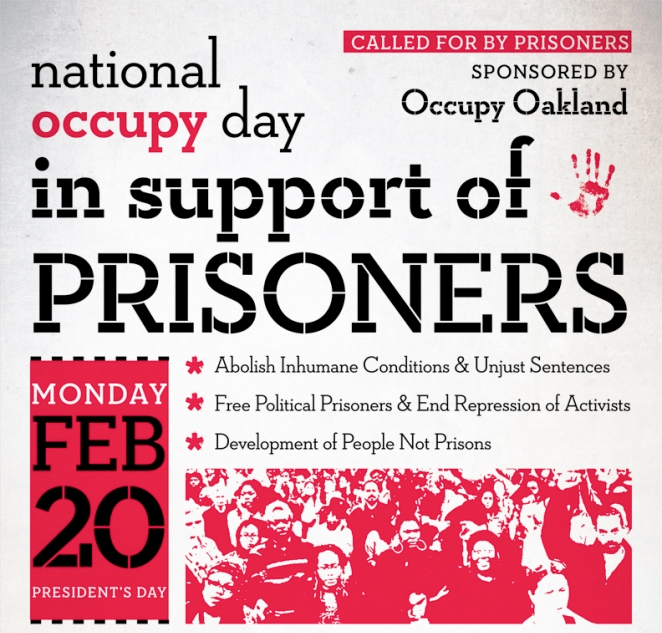
Pelican Bay Human Rights Movement Hunger Strikers in Solidarity (PHSS)
Sitawa Jamaa, s/n Dewberry C35671; Todd Ashker C58191; Antonio Guillen P81948; and Arturo Castellanos C17275
Corporate Amerika has coalesced its efforts around the exploitation of Human Beings, while using the political apparatus of the U.S. government, federal, state and local to institute policies that set in motion the creation of a corporate police state, which has targeted the poor as a surplus for incarceration and exploitation.
Those of us housed in solitary confinement throughout California and Amerika, support “Occupy Wall Street” and understand the necessity to resist against corporate greed. We will no longer willingly accept the subjugation, oppression and exploitation of Humanity.
Banks and the “prison industrial complex” are corporate empires that prey on the souls of Humanity. Therefore we officially join you all in Struggle.
Mumia Abu-Jamal: Souls on Ice
When I heard of the call, just raised in Oakland, California, to “Occupy the Prisons,” I gasped.
It was not an especially radical call, but it was right on time.
For prisons have become a metaphor; the shadow-side, if you will, of America, With oceans of words about freedom, and the reality that the U.S. is the world’s leader of the incarceration industry, its more than time for the focused attention of the Occupy Movement.
It’s past time.
For the U.S. is the world’s largest imprisoner for decades, much wrought by the insidious effects of the so-called ‘drug war’—what I call, “the War on the Poor.”
And, Occupy, now an international movement, certainly has no shortage of prisons to choose from. Every state, every rural district, every hamlet in America has a prison; a place where the Constitution doesn’t exist, and where slavery is all but legalized.
When law professor Michelle Alexander took on the topic, her book, the New Jim Crow, took off like hotcakes – selling over 100,000 in just a few months.
And where there are prisons, there is torture; brutal beatings, grave humiliations, perverse censorship–and even murders—all under a legal system that is as blind as that statue which holds aloft a scale, her eyes covered by a frigid fold of cloth.
So, what is Occupy to do?
Initially, it must support movements such as those calling for the freedom of Lakota brother Leonard Peltier, the MOVE veterans of August 8th, 1978, the remaining two members of the Angola 3 (Herman Wallace and Albert Woodfox), Sundiata Acoli, Russell “Maroon” Shoatz, and many other brothers and sisters who’ve spent lifetimes in steel and brick hellholes.
But, the Occupy Movement must do more.
As it shifted the discussion and paradigm on economic issues, it must turn the wheel of the so-called ‘Criminal Justice System’ in America, that is in fact, a destructive, counter-productive, annual $69 billion boondoogle of repression, better-known by activists as the Prison-Industrial-Complex.
That means more than a one-day event, no matter how massive or impressive. It means building a mass movement that demands and fights for real change, and eventually abolition of structures that do far more social damage than good.
It means the abolition of solitary confinement, for it is no more than modern-day torture chambers for the poor.
It means the repeal of repressive laws that support such structures.
It means social change—or it means nothing.
So let us begin—Down With the Prison Industrial Complex!
Lynne Stewart
This occupy rally is what Must happen at every jail in the United States–a direct challenge to Arbitrary Power that thinks it can lock up those with the greatest grievances against the system and systematically demonize them to their fellow citizens. I speak now for all the 2 Million but of course, particularly on behalf of those political prisoners who actively fought and tested this unjust system and now suffer in SHUs, and other forms of Solitary, for that. Many have been tortured for the last thirty years or more. When they were captured in the heady political days of the ’60s and ’70s, we were convinced that fundamental change was inevitable –indeed that it was right around the corner. It still remains inevitable but now we understand the protracted struggle necessary to breach this evil system. I for one am recruited to accomplish the freedom of political prisoners and as my comrade Chairman Fred says “FREE ‘EM ALL!!!”
Khalfani Malik Khaldun
All power to the people. I am in support/solidarity with your work to expose the contradictions existing at San Quentin prison, and all prisoners across the country.
Please extend my clenched fist salutation to brother Kevin Cooper/those men on death row.
I am a political prisoner here in Indiana. I have been in prison for 26 years now, with 18 years in isolated confinement. I am currently being held in a Secure Housing Unit, where the conditions are cruel and unusual punishment, and there are deplorable violations of state and federal policy all across the unit.
Those in charge have used criminal tactics to keep many of us in perpetual isolation. We could use some organized, principled help here in Indiana. Could you provide me and e-mail or other address of other occupiers in solidarity against prison injustice? We need to organize a force here to Occupy the Indiana SHU. I have some committed supporters…along with others we can move mountains. I agree with Kevin: just never forget us.
Kevin Cooper: We Dissent – An Occupy Death Row Production
A few of the definitions of the word dissent are: to withhold assent; to differ in opinion; difference of opinion; religious nonconformity; a written statement in which a justice disagrees with the opinion of the majority.
The above word “Dissent” and these few definitions speak in part to what all the different “Occupy Movements” are about.
While they all, each and every one of them, have different thoughts, ideas, tactics, agendas, and people who they represent, they all have, for the most part, “dissented” from what has been going on, and going on for decades, in this world and country.
We all disagree with, and do not want to be part of, the norm anymore! Nor do we want what is considered “normal” to be part of us, because the status quo is outright harming us on all of life’s different levels.
We all are saying in our own unique way that we don’t trust the people who are running the system, just as we don’t trust the system itself.
All across the world, people who don’t eat the same food, or wear the same garb, speak the same language, belong to the same religion or pray to the same named God, if they do pray, are dissenting.
Everywhere, people are standing up and fighting back, and speaking out from under the universal umbrella of humanity. This umbrella provides protection for the oppressed, from the oppressor.
The Occupy Movement as a whole is another form of the universal umbrella for human rights. From within this movement, we dissenters can speak the truth as to how the status quo, the ruler’s agenda, has a negative effect on “We the People” and this one planet we all must live on, and share.
Something must be seriously wrong and it is not us! The system is wrong and it has always been wrong and will always be wrong!
Some in the top 1% use their subordinates to ask, “What is it that they want?” Each movement within Occupy may want different things, especially since we all come from different places and have different real life and death experiences.
So while I can’t speak to what any one movement wants per se, I can speak to what all these different occupy movements don’t want.
We don’t want terrorism of any kind, against any people. We don’t want pollution of the air or water and other natural resources that Mother Earth produces; We don’t want a government that uses the mainstream news media to help a President send its people to war based on lies; We don’t want war in any of its forms; We don’t want sexism, racism, classism, or poverty!
We don’t want corruption, the death penalty, the prison industrial complex — either public or private prisons. We don’t want unions to be busted, nor do we want jobs sent overseas to other countries. We don’t want to go without healthcare or a good education. We don’t want police brutality or intimidation of any kind!
These few things mentioned above should go a long way to help people understand that there are two sides to every story, and while many seem to want to focus on just one side… “What is it that they want?” they must now come to terms with some of what we don’t want! If they do, then they will truly understand why we dissent. Everything that we don’t want is a very real part of what is wrong within this country and world, and it is having a very negative affect on the quality and quantity of life of the masses of people—the poor!
All these manmade ills are happening and have happened simply because of greed and the very real fact that the powers that be – They really don’t care about us!
So, we respectfully dissent!
Jane Dorotik
The 2.3 million individuals that we as a nation incarcerate has become one of the defining qualities of this country of ours. Never before in the history of civilization has a country locked away so many of its own people. Have we as society become so violent, so incorrigible that we must lock away so many? How did we get to this point under the guise of ‘public safety?’
The cost of incarcerating women is immense. The average annual cost to incarcerate a woman is $50,000 and the average cost to incarcerate a woman over 55 is a staggering $138,000. Because of their role as mothers, the costs and consequences go far beyond the criminal justice system. Their children are either raised by other family members or are sent to the state’s foster care system. Children whose parents are incarcerated are 4-5 times more likely to become incarcerated themselves, thus perpetuating the intergenerational incarceration cycle. Since 1991, the number of children with a mother in prison has increased by more than 131% and nationwide more than half of children whose mothers are incarcerated are under age 10.
The prison system is a system gone awry, gravely compromised and rampant with abuses. It is a terrifying breeding ground for anger, hatred, sexism, homophobia and dominating exploitation of other human beings. We are warehousing people, punishing them and then returning them to society worse off than when they entered the system. The violence that then comes out of these prisons is a much greater threat to public safety than any foreign terrorist group ever could be.
Krista Funk
The bankers are legal racketeers. They are rewarded for their crimes. But the people at the bottom of the 99%, the poor, we are warehoused in the Prison Industrial Complex. They take away our ability to vote once we are inside because that might change the way things are. The rich get richer, the poor give up, and out of desperation they turn on their families and their communities. This cycle has to change!
Herman Wallace
Most all U.S. citizens benefit in some way from the capitalist mode of production, a system that exploits underdeveloped nations as well as 99% of its own nation’s people. This creates a vast contradiction that causes much emotional pain.
In 1865, Union Generals admitted to Lincoln that they were on the verge of losing the war and could only turn the tides if Lincoln would free the slaves. Of course, slaves were never freed; it was only the form of slavery practiced in the South that was disrupted, moving from chattel slavery to wage slavery as has been so well documented.
Defy permits to occupy, civil disobedience is a form of struggle, and where there is no struggle, there is no change.
We must strengthen our forces by uniting with the Occupy movement and liberation movements throughout the world in order to disrupt the capitalist mode of production and send capitalism to its grave.
Free All Political Prisoners and Prisoners of Consciousness
All Power to the People
Robert King
First of all I would like to applaud and salute those in the Occupy movement for focusing on the hideous corruption of corporate America and the effects this corruption has on all of us in the 99%, including the well over two million individuals that fill our detention facilities and their families.
Being in prison, in solitary was terrible. It was a nightmare. My soul still cries from all that I witnessed and endured. It does more than cry – it mourns, continuously. I saw men so desperate that they ripped prison doors apart, starved and mutilated themselves. It takes every scrap of humanity to stay focused and sane in this environment. The pain and suffering are everywhere, constantly with you. But, it was also so much more than that. I had dreams and they were beautiful dreams. I used to look forward to the nights when I could sleep and dream. There’s no describing the day to day assault on your body and your mind and the feelings of hopelessness and despair.
There is far more than a casual relationship between the Occupy Movement and the work so many of you are doing to change the criminal justice system.
The same people who make the laws that favor the bankers, make the laws that fill our prisons and detention centers. We have to continue to make the connection between Wall St. and the prison industrial complex. The growth of the private prison industry is just one symptom of this unholy alliance.
I stand in solidarity with the Occupy 4 Prisoners rally and hope these rallies shed further light on the insidious effects of prisons for profit and politics.
Free all political prisoners and prisoners of conscience.
Steve Champion
I want to thank all the participants of Occupy San Quentin for being here today. Thank you for reading my statement.
My name is Steve Champion. I’ve been incarcerated for over 30 years and twenty-nine of those years and counting, have been spent on San Quentin’s death row.
We are living in a critical time in history. There is a global and domestic crisis going on. Our body politics is under siege because it is dominated by crony capitalism and social and economic indifference. We are fast moving toward a bicentric society of “haves” and “have nots.” If we fail to take a strong stand to transform this nation then we can expect an ill forecast for the future.
One of the most powerful unions in the state of California is the Correctional Peace Organization Association (CCPOA). As tuition for students are being raised, schools being shut down, cuts being made in the fields of education, social programs, nurses and other care-givers, everyone is being forced to make a sacrifice. But we don’t hear cuts being made in the salaries of prison guards. Why is that? Because the CCPOA (through rigorous lobbying in Sacramento) have the ear of California State Legislators. They make huge campaign contributions to both the Governor and State Legislators. This allows them to peddle influence and get implemented the policies they want in place.
What this ought to tell those of us who are concerned about social justice, prison reform and the abolishment of the death penalty is we have to up the ante of our struggle. If we want to see the eradication of the death penalty and the prison, it requires a multifaceted approach. It is not enough for prisoners to struggle on the inside; it is not enough to picket, protest or occupy specific places. Those things are important. But we also need to have a robust voice and seat among the decision makers who shape, influence and create policies that we vehemently oppose. We need to build a grassroots political organization to challenge those in power.
Too often, our social movements are on the defensive. We react as opposed to being proactive and taking initiative on programs we want implemented and policies we want changed. Building a grassroots political organization can facilitate a lot of the fragmentization that exists in our movements by uniting us. It would give focus to our objectives. If we don’t do this, then who? If we don’t do this now, then when?
The one percent who dominate the political and economic system in this country is not an accident. It was carefully planned. They want a government for the one percent and by the one percent, but not by the people.
We have to strengthen and intensify our struggle. We have to become more committed. We have to remember that our struggle isn’t a sprint, but a marathon. What we do today will alter the course of history tomorrow. Thank you.
Long live the struggle.
Todd Ashker
You all know we’ve been on a “counter propaganda” campaign here [in Pelican By State Prison] since Dec. 09 and much of what myself, Castellano, Sitawa, and Mutope have in mind in our writings about our struggle and resistance 24/7 is in line with our counter propaganda campaign!! Actually, I’d prefer criminal prosecution because 1) I’d be acquitted and 2) the publicity it would garner would be real great for the cause. Now that it’s not a DA referral (I expect due to legislative inquiry), I expect to be railroaded & found guilty administratively (first time guilty of a serious rule violation since Jan 94).
This will be used by the Board of Parole Hearings to issue me a longer parole hearing deferral when I go in Aug 2012 (probably a 7-10 year deferral). It will mean no art material or photos for a year, etc., etc., etc. This bogus CDC 115 RVR should be getting propagated out there as much as possible as well as other CDCR/PBSP dirty shit.
This is where I (and many others) stand on this struggle: For more than 30 years CDCR policy and practice has been “us vs. them” — viewing us as the enemy who they are at war with.
The 1st thing one does in war is propagate against and dehumanize the enemy. For 22+ years PBSP has been propagated as housing “the worst of the worst,” responsible for all the state’s gang problems.
We see it in reverse. CDCR (the prison industrial complex) are the criminals committing multi billions in fraud and many murders each year (law makers and courts are enablers and just as guilty). CDCR is housing us to put money in their pockets, all of which is part of the bigger problems – the class war in this country: the 1% vs. the 99% (the ultra rich v. poor). It’s no longer a “people of color v. white man” issue; it’s a “poor v. ultra rich” issue. The so-called middle class is long gone.
We’re at war (the poor 99% including the prisoners) and the people in power are scared to death and they should be. Most of us should have been out long ago. A life sentence has never meant “life” until the last 30 years. Most of us are many years beyond our minimum eligible parole dates.
We’re not serving a legally valid sentence anymore. We’re here illegally, immorally, and unethically based on politics and money.
Our supporters need to propagate against the system at every opportunity and tie our struggle to that of the poor and disenfranchised at large. This is just the start. We plan to force CDCR to open up all the level IV General Populations and spend money on our benefit, such as rehab programs, etc. and force change to sentences and paroles.
Our supporters need to see the system for what it really is and to educate people about it to bring more support in. It’s important to humanize and decriminalize us to the mainstream. Granted we’re “convicted felons,” but we’ve already served above and beyond any form of a valid prison term.
We shouldn’t even be recognizing that these CDCR “criminals” have any power over us. We really should be actively resisting our illegal confinement a lot more and our people outside should be doing so too, with all of our beings, until these “criminals” cut us loose or kill us.
Right now we’re waiting – waiting to get out to these General Population prisons. Then we’ll straighten out the B.S. on them so these people can no longer justify warehousing everyone. Then, we’ll go from there. People need to realize these “criminals” are the real enemy who we’re at war with and act accordingly in a smart way. The time is coming when they will fall and it’s not too far in the future. But we all must stay strong and do our part to make it happen. We need strong outside support. People should not fear nor be intimidated by CDCR’s “crime syndicate” staff. They’re really cowards in truth and need to be forced to get right.
As always, I send my best to all.
FROM CCWP WOMEN (Alisha, Veronica, Margarita)
Truth is…
The picture I’m about to paint can only be heard,
so listen closely to every word.
Innocent until proven guilty?
They can’t be serious,
In a system where
Drug dealers get more time
than serial killers,
juveniles get tried as adults,
before they become one.
I guess nobody musta warned’em
about playing with knives and guns.
Guilty by association?
That’s what it’s called
then they get hauled
off to the pen,
where some girls become boyz and some boyz
become women.
Sitting around
unaware of who they are,
wounded while in the belly of the beast.
I call’em invisible scars,
the kind that can’t be healed
by Neosporin and stitches.
Went in walkin’
came out switching.
Could you imagine what it’s like?
Being told that the beginning
is really the end of your life.
3 strikes and you’re out!
Some think it’s a game,
but it’s really outta my hands.
Lord knows, I’m not tryna do life
on installment plans.
Everybody wanna be a part
Of the occupy system,
I need to occupy my life and
find something to do with it,
otherwise it’s useless.
Some may mistake my words as verbally abusive,
But the truth is…
How do we expect our kids to grow
from concrete,
accept defeat,
have to fend for themselves
in cells where it is dark
and hot as hell?
More parents come to see kids in jail
than they do at graduations.
That’s cuz the new diploma
is parole or probation
Fucked up situation
No contender.
“Now I’ll be gone until November”
Listening to a public pretender
telling me to plea
Y?
Cuz I’m young, black, and sell crack in da streets.
Babies committing robbery,
1st degree.
Even with blind eyes
I could see it ain’t cool.
They building prison programs
and tearing down schools.
We all got an opinion
just like we all have a choice.
No one can hear you speak
if you don’t use your voice!
Veronica Hernandez
My name is Veronica Hernandez and I am a 20-year-old young woman that has been incarcerated since I was 16-years-old and tried as an adult at 17-years-old.
Prior to being charged as an adult I was appointed a no-good attorney that couldn’t have cared less about me or the outcome of my case and consequently had put absolutely no effort into representing me adequately. There are no law libraries or legal services at Juvenile Hall so a juvenile rather it be for better or for worse had literally no choice but to be dependant on his or her court-appointed attorney and trust that him or her will lead them in the right direction. Unfortunately, for me that direction was to adult court where I now face a life sentence should I be convicted.
In California, peopel who are 16-years-old are eligible to be tried as adults and in some states, the minimum age to be tried as an adult is 13-years-old and in others, there is no age limit at all depending on the nature of the crime. Regardless of the age, juveniles that are tried as adults are subjected to harsher punishments that juvenile court judges lack the power to impose such as life without the possibility of parole or sentences that are so outrageous like “43 to life” or “51 to life” that those sentences might as well be life without the possibility of parole.
Although a juvenile’s right to a hearing before a case can be transferred to adult court was established by Kent V. U.S. (U.S. Sup. Ct. 1966) there are still cases that get transferred to adult court without a hearing at all and that is known as a “direct filing.” The D.A. can file a direct filing on a juvenile that is 14-years-old or older and that contradicts California’s so-called minimum age of 16-years old or older to be eligible at being tried as an adult and a juveniles so-called right to a hearing.
The human mind doesn’t stop developing until the age of 25, so it is ridiculous that a judge can even be given the power to determine that a juvenile can never be rehabilitated and will remain at the same state of mind that the juvenile was in at the time of their crime was committed for the rest of his or her life. Aside from ridiculous…it is outrageous…oppressive…opprobrious…and something that needs to cease…abolish this oppression and give children the chance at life that each and everyone of them deserves.
Sean Swain: Occupy, Liberate, De-Colonize: A Statement for Occupy Columbus from Prison
In 2007, in a published interview I observed that if Ohio prisoners simply laid on their bunks for 30 days, the system would collapse. I wasn’t talking about just the prison system, but Ohio’s entire economy.
I came to that conclusion because I recognized that 50,000 [Ohio] prisoners work for pennies per day making the food, taking out the trash, mopping the floors. We produce parts for Honda and other multi-nationals at Ohio Penal Industries (OPI), making millions of dollars in profit for the State. If we stopped participating in our own oppression, the State would have to hire workers at union-scale wages to make our food, take out the trash, and mop the floors; slave labor for Honda and others would cease.
Ohio would lose millions of dollars a day in production. The State’s economy would not recover for a decade.
When I made that observation, I didn’t know for certain that I was right. I suspected I was. But more than a year later, prison officials came to get me. My cell was plastered with crime tape. All of the fixtures, including lights, sink, and toilet, were removed and inspected, something that I haven’t seen happen in 20 years of captivity. I was taken to segregation and slated for transfer to super-max.
The reason? My observation in a year-old published interview, that Ohio’s economy would collapse without prison labor. That’s when I knew my observation was right. The enemy confirmed it.
I eventually avoided super-max because friends and supporters made enough noise, but I am now on a Security Threat Group list even though I have never been part of any organization, and my incoming mail is screened.
I share all of this in order to underscore how seriously and irrationally terrified the state is about the possibility of anyone awakening the prisoner population to its own power. The state is hysterically shit-their-pants petrified of an organized prisoner resistance, the way plantation owners feared a slave uprising.
I was subjected to repression in 2008. Since then, the situation for the State has become even more dire. Given austerity cuts and privatization of a few prisons, the guard-to-prisoner ratio has drastically dropped, leading to more disruption in the standard prison operations. On top of that, the Kasich administration’s efforts to bust public workers’ unions, though a failure, has destroyed the morale of guards and staff, the majority of whom now only care about collecting their pay checks. With each downturn in the economy, the prison system takes more essential services from prisoners – from medical to food to clothes – and thereby increases hostility and resentment of the prisoner population.
With very little effort, very little money, and a great deal of advanced planning, Ohio’s prison population could be inspired to completely disrupt the operation of the entire prison complex. If such a disruption were to occur, it would cause more than the economic collapse of the State that I already discussed. Such a disruption would ultimately seize from the State the power the power to punish. This would pose more than a simple political problem for the government: in such a scenario, it loses all power to enforce its edicts and impose itself; the government ceases to be the government.
Such a development would be a great benefit to the Occupy Movement. While Occupy directly challenges the crapitalist system, it must be remembered that the global crapitalist matrix uses governments as factory managers. If you protest private bankers, you get beaten by public cops. Given the recent bail-outs, the public trust is nothing more than a corporate slush-fund. It is nearly impossible in this blackwater-enron out-source era to tell where governments end and corporations begin – and vice-versa.
The prison complex is an essential component to the larger crapitalist matrix. If an Occupy-prisoner collaboration in Ohio could take the prison system out of the enemy’s control – if the Occupation could expand to the prisons – we can collectively create a prototype for the larger movement to replicate, building momentum that collapses prison complex after prison complex, paralyzing state government after state government, spreading like a computer virus, liberating and de-colonizing the most-essential and intimidating bulwark against freedom the empire relies upon: the prisons.
For those of you who are part of the 99% but don’t really want to identify with this segment of the 99% and object to the possibly causing all of these criminals to go free, I remind you: The most hardened and irremediable criminals, the most ruthless killers and rapists, currently run the Fortune 500; they dictate U.S. foreign policy; they drive cars emblazoned with “To Protect and To Serve”. You serve the agenda of those criminals if you turn your back on these “criminals.” Without us, you’re not the 99%. If my math is right, without us, you’re only about 94%.
This 5% is only waiting for the invitation. You can let your enemy keep his slaves and possibly defeat you over time, or you can liberate his slaves and defeat him quickly. To me, it’s a no-brainer. It’s a matter of actually living up to what you present to be – something your enemy has never done.
We’re still waiting for that invitation.
Gerardo Hernandez
On behalf of the Cuban 5 we send you our solidarity on this the National Occupy Day in Support of Prisoners. We know first hand about the injustice inherent in the U.S. judicial system. In our case we are serving long sentences for defending our country against terrorist attacks by monitoring groups whose whole existence is to carry out violent acts against Cuba. It is our hope that what you are doing today will bring attention to the plight of those behind bars and help bring about a more humane society that provides jobs, housing, education and opportunity instead of incarceration.
A big embrace to you all
Venceremos!
Leonard Peltier
From inside a prison cell I call out to you. Hello to Mumia Abu Jamal supporters. Hello to Troy Davis supporters. Hello to Occupy Oakland. Hello to my own supporters. Hello to everyone else whose conscience compels you to gather here today. I’m so thankful this country and the world still has people who look beyond their own lives and their own condition to remember others who for different reasons have become victims of a deeply flawed justice system. I believe whenever people gather together with an interest of the common good of all men in their hearts, that is a sacred gathering and pleases the Creator. For what man is a man and what woman is a woman who does not try to make the world a better place?
Today in the shadow of San Quentin, the belly of the beast housing 700 men the state wants to kill, you come together to speak of injustice and reform. While they will not come out and say it, I have been given a life sentence for a crime I did not commit. I defended my people from a government waging war on defenseless elders and traditional believers. Many friends of mine died in that war, and because two FBI agents also died, I have been in jail for 36 years. I have been held despite evidence the government withheld and manipulated evidence, coerced witnesses, and did all they could do to keep me from proving my innocence. I have been held longer than their own laws say I should be. All because I am a symbol and a reminder of what they will do to anyone who stands up against their authority. But all this shows is that they only have violent access to authority. They do not have righteousness or decency or even legality on their side. Throughout history all such systems that ignored justice and rights to rule by force eventually fell.
We have seen that minorities are incarcerated far more and for far longer periods of time than Caucasians. We further know that minorities receive the death sentence in far greater numbers. We know poor people get convicted and serve longer than those with money and influence. Even if you support a death penalty these facts alone indicate that we must have a moratorium on executions until we can rectify these issues. It’s the only reasonable alternative to continuing a racist and biased system.
I believe a civilized country does not commit murder. Murder is not justice no matter the crime or situation. Justice is all parties agreeing on a suitable outcome. Murder does not bring closure to anyone or any situation. Murder does not create healing. We know that America has executed innocent people. We further know more innocents will die unless this system is rebuilt from the ground up. It is true that for those working to right these wrongs, the life you save may be your own.
And so my friends I ask you to look around. Look at your friends and family and allies. Appreciate them and support one another, for in doing so you support myself, Mumia, and so many others wrongly serving time. Know that I am with you and appreciate your efforts. Know that I am in the water that refreshes you, in the food that nourishes you, and in the air that sustains you. You cannot lock justice within walls or bars. Justice surges through all of us and unites us. Justice has done more to further the advance of mankind’s endeavors than any gun or weapon. Thank you for your belief in Justice. Thank you for your time. Thank you for your love. Thank you my brothers and sisters. Thank you.
Mitakuye Oyasin, We Are All Related
Herman Bell
In your pushback for social justice, you give us hope. Failure to claim your rights is failure to know whether they exist or not. Abstract terms though they be, you make them real. A parasitic social order has fully emerged and affixed itself to our existence and now requires our unquestioned loyalty and obedience to its will. And we have come dangerously close to complying.
Ordinary people doing uncommonly brave things have rekindled our hopes that we can do better this time in safeguarding the public trust. Far too many of us have grown complacent in our civic and moral responsibility, which explains in part how Wall Street, big banks, and corporations, in political connivance, have gotten away with so much. So we have to take some responsibility for that.
I think we are now coming to understand that. Your occupation in these troubling times calls attention to much of what is wrong in our society. So keep it tight: no elitism, no arrogance, no divisiveness, and consult the elders as you go forth, because youth often do the wrong thing for the right reason.
And in a clear, unwavering voice wherever you go, wherever you speak, wherever you occupy, demand release of our political prisoners, for they are the embodiment of our movement’s resolve. And don’t let anyone punk you out, because what you do matters. Big jobs call for big people and you already stand pretty tall in my eyes.
David Gilbert
Your creativity, energy, and love of humanity bring warm sunshine to many of us behind these prison walls. You’ve eloquently and concisely articulated the central problem: a society run by the 1% and based on corporate greed as opposed to human need. That obscenity of power and purpose creates countless specific and urgent concerns. Among those, the criminal injustice system is not just a side issue but essential to how the 1% consolidate power.
The U.S. mania for putting people behind bars is counterproductive in its stated goal of public safety. A system based on punishment and isolation breeds anger and then difficulty in functioning upon return to society – things that generate more crime. The U.S., which imprisons people at about seven times the rate of other industrialized countries, has a higher rate of violent crime. Punishment does not work. A transformative, community-based justice model would be more effective as well as more humane. It would both support victims and work with offenders, to enable them to function well and make a positive contribution.
Although the punitive approach does not make communities safe, it has served the rulers well. In the same 30 years that the 1% nearly tripled their share of U.S. national income—with global inequities far steeper—the number of people behind bars in the U.S. went up from about 500,000 to 2.3 million. It’s no coincidence. The “war on crime” started in 1969 as a code for attacking the Black Liberation Movement, at a moment when that movement was at the front of a widespread wave of radical social action which seriously threatened the dominance of the 1%. Mass incarceration, especially of people of color, was an important part of the 1%’s strategy for holding on to their wealth and power.
The second way the criminal injustice system works to keep the powerful in power is that as the 1% steal more and more of humanity’s wealth, they face the pressing political need of deflecting attention from their colossal crimes. Over the past 30 years mainstream politics have been driven by a series of coded forms of racial scapegoating—against “criminals,” welfare mothers, immigrants, Muslims, the poor who get token concessions from the government—to turn the frustration and anger of the majority of white people away from the rulers and toward the racially constructed “other.” Confronting that demagogy and hatred is critical to resisting the 1%’s offensive.
As activists, we often grapple with a tension between prioritizing the needs of the most oppressed—based on race, class, gender, sexuality, ability—and maintaining a universal vision and broad unity. But those two important concerns are not in contradiction. The only road to principled and lasting unity is through dismantling the barriers formed by the series of particular and intense oppressions. The path to our commonality is solidarity based on recognition of—and opposition to—the ways this society makes us unequal. Our challenge is to forge this synthesis in practice, on the ground, in the daily work of building the movement of the 99%.
With an embrace to you and your inspiring stand, one love.
Jalil A. Muntaqim
The 2.3 million U.S. citizens in prison represent more than a problem of criminality. Rather, the human toll of the U.S. prison industrial complex addresses and indicts the very foundation of America’s history.
In 1865, the 13th Amendment of the U.S. Constitution served to institutionalize prisons as a slave system. “Neither slavery nor involuntary servitude, except as a punishment for crime….shall exist within the United States.”
This Amendment evolved out of the Civil War allegedly to abolish chattel slavery. However, since that time, prisons have become an industrial complex. As an industry, its investors are financial institutions such as Goldman Sachs & Co., Prudential Insurance Co. of America, Smith Barney Shearson, Inc., and Merrill Lynch & Co. Understand, these investors in this slave industry in 1994 are no different from investors in the slave system prior to 1865.
The political system supports this industry by passing laws that enhance criminal penalties, increase penal incarceration and restrict parole. Former U.S. President Clinton’s 1985 Crime Bill effectively caused the criminalization of poverty, exponentially increasing the number of people being sent to prison. On May 12, 1994, the Wall Street Journal featured an article entitled, “Making Crime Pay: Triangle of Interests Created Infrastructure to Fight Lawlessness; Cities See Jobs; Politicians Sense a Popular Issue and Businesses Cash In—The Cold War of the ‘90s.” The article clearly indicated how prisons have become a profitable industry, including so-called private prisons.
Given this reality, the struggle to abolish prisons is a struggle to change the very fabric of American society. It is a struggle to remove the financial incentive—the profitability of the prison/slave system. This will essentially change how the U.S. addresses the issue of poverty, of ethnic inequality, and misappropriation of tax dollars. It will speak to the reality that the prison system is a slave system, a system that dehumanizes the social structure and denigrates America’s moral social values.
The prison system today is an industry that, as did chattel slavery, profits off the misery and suffering of other human beings. From politicians to bankers to the business investment community, the prison industrial complex is a multi-billion dollar criminal enterprise, all of which has been sanctioned by the 13th Amendment of the U.S. Constitution.
It is imperative that those of you here come to terms with the reality that America is the prison industrial complex, and that the silence and inaction of Americans is complicit in maintaining a system that in its very nature is inhumane.
Abolish the American prison industrial complex!!
All Power to the People! All Power to the People! All Power to the People!
Occupy Oakland is Dead. Long Live the Oakland Commune.
BY SOME OAKLAND ANTAGONISTS
May 2012 from bayofrage.com
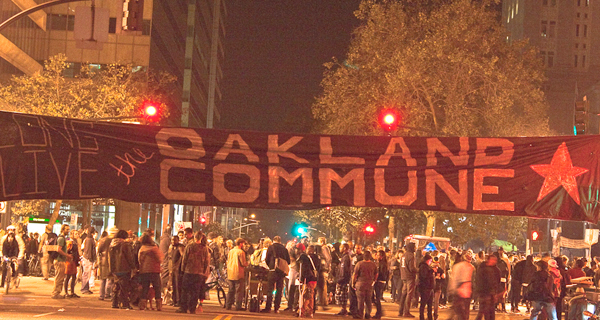 For those of us in Oakland, “Occupy Wall Street” was always a strange fit. While much of the country sat eerily quiet in the years before the Hot Fall of 2011, a unique rebelliousness that regularly erupted in militant antagonisms with the police was already taking root in the streets of the Bay. From numerous anti-police riots triggered by the execution of Oscar Grant on New Year’s Day 2009, to the wave of anti-austerity student occupations in late 2009 and early 2010, to the Native protest encampment at Glen Cove in 2011, to the the sequence of Anonymous BART disruptions in the month before Occupy Wall Street kicked off, our greater metropolitan area re-emerged in recent years as a primary hub of struggle in this country. The intersection at 14th and Broadway in downtown Oakland was, more often than not, “ground zero” for these conflicts.
If we had chosen to follow the specific trajectory prescribed by Adbusters and the Zucotti-based organizers of Occupy Wall Street, we would have staked out our local Occupy camp somewhere in the heart of the capitol of West Coast capital, as a beachhead in the enemy territory of San Francisco’s financial district. Some did this early on, following in the footsteps of the growing list of other encampments scattered across the country like a colorful but confused archipelago of anti-financial indignation. According to this logic, it would make no sense for the epicenter of the movement to emerge in a medium sized, proletarian city on the other side of the bay.
We intentionally chose a different path based on a longer trajectory and rooted in a set of shared experiences that emerged directly from recent struggles. Vague populist slogans about the 99%, savvy use of social networking, shady figures running around in Guy Fawkes masks, none of this played any kind of significant role in bringing us to the forefront of the Occupy movement. In the rebel town of Oakland, we built a camp that was not so much the emergence of a new social movement, but the unprecedented convergence of preexisting local movements and antagonistic tendencies all looking for a fight with capital and the state while learning to take care of each other and our city in the most radical ways possible.
This is what we began to call The Oakland Commune: that dense network of new found affinity and rebelliousness that sliced through seemingly impenetrable social barriers like never before. Our “war machine and our care machine” as one comrade put it. No cops, no politicians, plenty of “autonomous actions”; the Commune materialized for one month in liberated Oscar Grant Plaza at the corner of 14th & Broadway. Here we fed each other, lived together and began to learn how to actually care for one another while launching unmediated assaults on our enemies: local government, the downtown business elite and transnational capital. These attacks culminated with the General Strike of November 2 and subsequent West Coast Port Blockade.
In their repeated attacks on Occupy Oakland, the local decolonize tendency is in some ways correct.[1] Occupy Wall Street and the movement of the 99% become very problematic when applied to a city such as Oakland and reek of white liberal politics imposed from afar on a diverse population already living under brutal police occupation. What our decolonizing comrades fail to grasp (intentionally or not) is that the rebellion which unfolded in front of City Hall in Oscar Grant Plaza does not trace its roots back to September 17, 2011 when thousands of 99%ers marched through Wall Street and set up camp in Lower Manhattan. The Oakland Commune was born much earlier on January 7, 2009 when those youngsters climbed on top of an OPD cruiser and started kicking in the windshield to the cheers of the crowd. Thus the name of the Commune’s temporarily reclaimed space where anti-capitalist processes of decolonization were unleashed: Oscar Grant Plaza.
Why then did it take nearly three years for the Commune to finally come out into the open and begin to unveil its true potential? Maybe it needed time to grow quietly, celebrating the small victories and nursing itself back to health after bitter defeats such as the depressing end of the student movement on March 4, 2010. Or maybe it needed to see its own reflection in Tahrir, Plaza del Sol and Syntagma before having the confidence to brazenly declare war on the entire capitalist order. One thing is for sure. Regardless of Occupy Wall Street’s shortcomings and the reformist tendencies that latched on to the movement of the 99%, the fact that some kind of open revolt was rapidly spreading like a virus across the rest of the country is what gave us the political space in Oakland to realize our rebel dreams. This point cannot be overemphasized. We are strongest when we are not alone. We will be isolated and crushed if Oakland is contained as some militant outlier while the rest of the country sits quiet and our comrades in other cities are content consuming riot porn emerging from our streets while cheering us on and occasionally coming to visit, hoping to get their small piece of the action.
The Movement
For a whole generation of young people in this country, these past six months have been the first taste of what it means to struggle as part of a multiplying and complex social movement that continually expands the realm of possibilities and pushes participants through radicalization processes that normally take years. The closest recent equivalent is probably the first (and most vibrant) wave of North American anti-globalization mobilizations from late 1999 through the first half of 2001. This movement also brought a wide range of tendencies together under a reformist banner of “Fair Trade” & “Global Justice” while simultaneously pointing towards a systemic critique of global capitalism and a militant street politics of disruption.
The similarities end there and this break with the past is what Occupy got right. Looking back over those heady days at the turn of the millennia (or the waves of summit hopping that followed), the moments of actually living in struggle and experiencing rupture in front of one’s eyes were few and far between. They usually unfolded during a mass mobilization in the middle of one “National Security Event” or another in some city on the other side of the country (or world!). The affinities developed during that time were invaluable, but cannot compare to the seeds of resistance that were sown simultaneously in hundreds of urban areas this past Fall.
It makes no sense to overly fetishize the tactic of occupations, no more than it does to limiting resistance exclusively to blockades or clandestine attacks. Yet the widespread emergence of public occupations qualitatively changed what it means to resist. For contemporary American social movements, it is something new to liberate space that is normally policed to keep the city functioning smoothly as a wealth generating machine and transform it into a node of struggle and rebellion. To do this day after day, rooted in the city where you live and strengthening connections with neighbors and comrades, is a first taste of what it truly means to have a life worth living. For those few months in the fall, American cities took on new geographies of the movement’s making and rebels began to sketch out maps of coming insurrections and revolts.
This was the climate that the Oakland Commune blossomed within. In those places and moments where Occupy Wall Street embodied these characteristics as opposed to the reformist tendencies of the 99%’s nonviolent campaign to fix capitalism, the movement itself was a beautiful thing. Little communes came to life in cities and towns near and far. Those days have now passed but the consequences of millions having felt that solidarity, power and freedom will have long lasting and extreme consequences.
We shouldn’t be surprised that the movement is now decomposing and that we are now, more or less, alone, passing that empty park or plaza on the way to work (or looking for work) which seemed only yesterday so loud and colorful and full of possibilities.
All of the large social movements in this country following the anti-globalization period have heated up quickly, bringing in millions before being crushed or co-opted equally as quickly. The anti-war movement brought millions out in mass marches in the months before bombs began falling over Baghdad but was quickly co-opted into an “Anybody but Bush” campaign just in time for the 2004 election cycle. The immigrant rights movement exploded during the spring of 2006, successfully stopping the repressive and racist HR4437 legislation by organizing the largest protest in U.S. history (and arguably the closest thing we have ever seen to a nation-wide general strike) on May 1 of that year [2]. The movement was quickly scared off the streets by a brutal wave of ICE raids and deportations that continue to this day. Closer to home, the anti-austerity movement that swept through California campuses in late 2009 escalated rapidly during the fall through combative building occupations across the state. But by March 4, 2010, the movement had been successfully split apart by repressing the militant tendencies and trapping the more moderate ones in an impotent campaign to lobby elected officials in Sacramento. Such is the rapid cycle of mobilization and decomposition for social movements in late capitalist America.
The Decomposition
So what then killed Occupy? The 99%ers and reactionary liberals will quickly point to those of us in Oakland and our counterparts in other cites who wave the black flag as having alienated the masses with our “Black Bloc Tactics” and extremist views on the police and the economy. Many militants will just as quickly blame the sinister forces of co-optation, whether they be the trade union bureaucrats, the 99% Spring nonviolence training seminars or the array of pacifying social justice non-profits. Both of these positions fundamentally miss the underlying dynamic that has been the determining factor in the outcome thus far: all of the camps were evicted by the cops. Every single one.
All of those liberated spaces where rebellious relationships, ideas and actions could proliferate were bulldozed like so many shanty towns across the world that stand in the way of airports, highways and Olympic arenas. The sad reality is that we are not getting those camps back. Not after power saw the contagious militancy spreading from Oakland and other points of conflict on the Occupy map and realized what a threat all those tents and cardboard signs and discussions late into the night could potentially become.
No matter how different Occupy Oakland was from the rest of Occupy Wall Street, its life and death were intimately connected with the health of the broader movement. Once the camps were evicted, the other major defining feature of Occupy, the general assemblies, were left without an anchor and have since floated into irrelevance as hollow decision making bodies that represent no one and are more concerned with their own reproduction than anything else. There have been a wide range of attempts here in Oakland at illuminating a path forward into the next phase of the movement. These include foreclosure defense, the port blockades, linking up with rank and file labor to fight bosses in a variety of sectors, clandestine squatting and even neighborhood BBQs. All of these are interesting directions and have potential. Yet without being connected to the vortex of a communal occupation, they become isolated activist campaigns. None of them can replace the essential role of weaving together a rebel social fabric of affinity and camaraderie that only the camps have been able to play thus far.
May 1 confirmed the end of the national Occupy Wall Street movement because it was the best opportunity the movement had to reestablish the occupations, and yet it couldn’t. Nowhere was this more clear than in Oakland as the sun set after a day of marches, pickets and clashes. Rumors had been circulating for weeks that tents would start going up and the camp would reemerge in the evening of that long day. The hundreds of riot police backed by armored personnel carriers and SWAT teams carrying assault rifles made no secret of their intention to sweep the plaza clear after all the “good protesters” scurried home, making any reoccupation physically impossible. It was the same on January 28 when plans for a large public building occupation were shattered in a shower of flash bang grenades and 400 arrests, just as it was on March 17 in Zucotti Park when dreams of a new Wall Street camp were clubbed and pepper sprayed to death by the NYPD. Any hopes of a spring offensive leading to a new round of space reclamations and liberated zones has come and gone. And with that, Occupy Wall Street and Occupy Oakland are now dead.
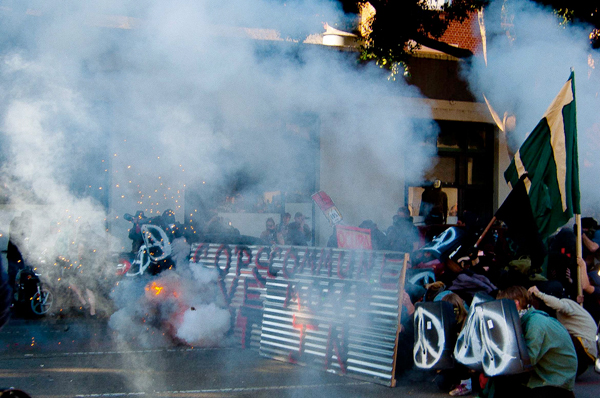
The Future
If one had already come to terms with Occupy’s passing, May 1 could actually be viewed as an impressive success. No other 24 hour period in recent memory has unleashed such a diverse array of militancy in cities across the country. From the all day street fighting in Oakland, to the shield bloc in LA, to the courageous attempt at a Wildcat March in New York, to the surprise attack on the Mission police station in San Francisco, to the anti-capitalist march in New Orleans, to the spectacular trashing of Seattle banks and corporate chains by black flag wielding comrades, the large crowds which took to the streets on May 1 were no longer afraid of militant confrontations with police and seemed relatively comfortable with property destruction. This is an important turning point which suggests that the tone and tactics of the next sequence will be quite different from those of last fall.
Yet the consistent rhythm and resonance of resistance that the camps made possible has not returned. We are once again wading through a depressing sea of everyday normality waiting for the next spectacular day of action to come and go in much the same way as comrades did a decade ago in the anti-globalization movement or the anti-war movement. In the Bay Area, the call to strike was picked up by nurses and ferry workers who picketed their respective workplaces on May 1 along with the longshoremen who walked off the job for the day. This display of solidarity is impressive considering the overall lack of momentum in the movement right now. Still, it was not enough of an interruption in capital’s daily flows to escalate out of a day of action and into a general strike like we saw on November 2.
And thus we continue on through this quieter period of uncertainty. We still occasionally catch glimpses of the Commune in those special moments when friends and comrades successfully break the rules and start self organizing to take care of one another while simultaneously launching attacks against those who profit from mass immiseration.
We saw this off and on during the actions of May 1, or in the two occupations of the building at 888 Turk Street in San Francisco or most recently on the occupied farmland that was temporarily liberated from the University of California before being evicted by UCPD riot police a few days ago. But with the inertia of the Fall camps nearly depleted, the fierce but delicate life of our Commune relies more and more on the vibrancy of the rebel social relationships which have always been its foundation.
The task ahead of us in Oakland and beyond is to search out and nurture new means of finding each other. We are quickly reaching the point where the dead weight of Occupy threatens to drag down the Commune into the dust bin of history. We need to breathe new life into our network of rebellious relationships that does not rely on the Occupy Oakland general assembly or the array of movement protagonists who have emerged to represent the struggle.
This is by no means an argument against assemblies or for a retreat back into the small countercultural ghettos that keep us isolated and irrelevant. On the contrary, we need more public assemblies that take different forms and experiment with themes, styles of decision making (or lack there of) and levels of affinity.
We need new ways to reclaim space and regularize a contagious rebel spirit rooted in our specific urban contexts while breaking a losing cycle of attempted occupations followed by state repression that the movement has now fallen into. Most of all, we need desperately to stay connected with comrades old and new and not let these relationships completely decompose. This will determine the health of the Commune and ultimately its ability to effectively wage war on our enemies in the struggles to come.
Notes
[1] The decolonize tendency emerged in Oakland and elsewhere as a people of color and indigenous led initiative within the Occupy movement to confront the deep colonialist roots of contemporary oppression and exploitation. Decolonize Oakland publicly split with Occupy on December 5, 2011 after failing to pass a proposal in the Occupy Oakland general assembly to change the name of the local movement to Decolonize Oakland. For more information on this split see the ‘Escalating Identity’ pamphlet: escalatingidentity.wordpress.com
[2] The demonstrations on May 1, 2006, called El Gran Paro Estadounidense or The Great American Boycott, were the climax of a nationwide series of mobilizations that had begun two months earlier with large marches in Chicago and Los Angeles as well as spontaneous high school walkouts in California and beyond. Millions took to the streets across the country that May 1, with an estimated two million marching in Los Angeles alone. Entire business districts in immigrant neighborhoods or where immigrants made up the majority of workers shut down for the day in what some called “A Day Without an Immigrant”.
It Didn’t Start with Occupy, and it Won’t End with the Student Strike! The Persistence of Anti-Authoritarian Politics in Quebec
BY ANNA KRUZYNSKI, RACHEL SARRASIN AND SANDRA JEPPESEN, Research Group on Collective Autonomy (Collectif de Recherche sur l’Autonomie Collecive or CRAC)*
What we are seeing today in Quebec, and particularly in Montréal, is a public moment of a much more ingrained movement that has been around for decades. If we use the rhizome analogy, we can better understand what is happening. A rhizome is like a root that runs underground: once in a while little shoots pop out above ground, and sometimes an enormous shoot breaks the surface. It is an analogy that suits the description of the anti-authoritarian movement in the province.
We could go back quite far in the history of social movements in Quebec to identify traces of this movement, but let’s start with what is now considered as the first large contemporary shoot which erupted through the surface, signalling a shift in the province’s political sphere. April 2001, Quebec City: huge street demonstrations took place protesting against the Third Summit of the Americas to negotiate the Free Trade Area of the Americas (FTAA). Building on a major wave of counter-globalisation protests that first erupted in North America in Seattle 1999, in Quebec City opposition to the FTAA was so widespread that politicians had a massive chain-link fence perimeter built – a perimeter that was rapidly torn down by protestors!
Prior to this pivotal moment, however, several smaller shoots were beginning to poke through the surface of calm in Quebec: 1) in 1997, Complexe G, which houses the Ministry of Education, was blockaded; 2) in 1998, a “commando bouffe” (food commando) was unleashed, where community activists went into the Queen Elizabeth Hotel and served themselves at the lunch buffet, bringing food to hungry people outside; 3) also in 1998, the Conseil du Patronat du Québec was occupied for three days. More recently, in June 2010, another big shoot sprang up, as Montreal activists were involved in the protests against the G8/G20 in Toronto. From our perspective, the Occupy Montreal movement that started in the Fall of 2011 following Occupy Wall Street, and the social justice mobilisation anchored in the on-going student strike, can also be seen as new shoots of this rhizomatic movement.
These moments of public protest represent a turning point in recent Quebec history for several reasons: 1) activists began explicitly targeting symbols of capitalism; 2) many people have been arrested with subsequent politicized trials; and most importantly, 3) they signalled the emergence of an anti-authoritarian movement that is at the heart of what we are seeing today. Indeed, all of these shoots emerged from a shared root, a political culture – a way of thinking, doing and being – grounded in shared values and principles which can be defined according to three main characteristics.
First, we can identify an explicit critique of the root causes of the social problems that we are facing, be it poverty, lack of access to public services, racial profiling, homophobia, gentrification, environmental degradation and the like. This explicit discussion links all of these problems to systems of exploitation – capitalism, colonialism, racism, patriarchy, heterosexism, etc. – that work together, reinforce each other, and disadvantage the majority of the world’s population. From the anti-authoritarian perspective, is it impossible to eradicate injustice unless these systems are all dismantled. This is precisely what we are hearing now in the streets when capitalism is named by the Occupy Movement as the source of the loss of our social services, and when students oppose tuition hikes because of the capitalist logic of the commodification of education.
Second, we find an explicit critique of representative democracy and the State, as well as experimentation with new types of political organization based on decentralised, horizontal direct democracy. This critique goes beyond denouncing corruption within traditional political institutions, and supersedes the notion that if we replace one political party with another, things will be better. It means that people who are directly affected by a political issue must be involved in the decision-making process on that issue. Anti-authoritarian activists believe that society is best managed closer to home, in smaller circles, in face-to-face deliberation that occurs in spaces such as general assemblies, consultas or spokescouncil meetings, through decision-making by consensus, and through implementation of decisions by member committees. At the core of this movement are two fundamental principles: self-determination and self-organisation. CLASSE is an excellent example—albeit not a perfect one—of this kind of organizing: general assemblies are held in departments, CEGEPS and universities, then delegates participate in weekly spokes-council meetings where they coordinate decisions and actions. There are no representatives, no presidents, no leaders, just people working together and experimenting with new, empowering, horizontal, and equitable social relations. People who speak to the media, though perhaps perceived as leaders, are simply spokespeople.
Third – last but not least – the movement isn’t constrained to one mode of expression but rather, we consider a rainbow of possibilities when it comes time to take action. This respect for a diversity of tactics, which has been at the heart of many controversial debates, is the result of over ten years of work by anti-authoritarians to get this principle accepted by mainstream social movements. This principle does not rest on the idea that anything goes in any given situation, but implies that the debate about the legitimacy of various tactics must occur within the movement, and should be decided for each situation by the people taking action themselves. Certainly the media should not make this decision for us. Indeed, we have all witnessed on many occasions how the mainstream media, along with state politicians, tend to create an image of the “good” versus the “bad” protestor in an effort to divide and conquer. This strategy has been used again against the current student strike activists. However, for the first time, movement “leaders” – or spokespeople – for the most part, have not denounced tactics such as economic disruption, contributing to the maintenance of a certain unity and a strong sense of solidarity within the movement.
The political culture described above is not consecrated into a platform or rulebook. Its values and principles are organic, spontaneous, and constantly evolving. To return to the rhizome metaphor, what happens underground or unseen between moments of eruption of big shoots is what builds the strength and collective empowerment of these important moments. People are working every day, in their communities – based on neighbourhoods, workplaces, shared identities or even just friend groups – to consolidate a burgeoning organisational interface that forms an anti-authoritarian commons. In order to reduce dependency on the capitalist economy, the movement sets up self-managed autonomous “services” – based on a mutual aid model – to satisfy specific needs identified by communities, such as alternative media, bike repair, autonomous libraries, collective kitchens, or childcare collectives, to name but a few. To control the means of production, the movement organizes self-managed cooperatives such as restaurants, book publishers, information technology providers, organic farmers, electricians, etc. Finally, in order to reduce dependency on mainstream media and cultural institutions, the movement has its own journalists, essayists, and researchers, as well as its own information sites, communication networks, radio shows, zines and newspapers. It also creates its own cultural institutions, such as the anarchist theatre festival, cabarets, video-making collectives, music venues or silk-screening spaces. And, because one cannot separate the private from the public spheres of life, anti-authoritarian principles are also fundamental to how kinship is practiced in the movement: in collective houses, intentional communities, party networks, etc.
Digging below ground level, we can see the anti-authoritarian roots underlying and nurturing the many smaller and larger shoots that have begun erupting over the past ten years. We can see what the mainstream media and public opinion might not notice, such as the links between what otherwise may appear as fragmented groups and collectives is an organisational interface that prefigures the kind of political, social and economic institutions we are building not just for tomorrow but also for today. This anti-authoritarian commons is part of a political alternative based on the two core principles of collective autonomy – self-determination and self-organisation – where people are taking things in their own hands instead of leaving them to a corrupt and disconnected corporate and state leadership. This is what is now happening in neighbourhoods all over Montreal where we hear pots and pans banging rhythmically in solidarity with the student strike and against the Liberal government, and where people are starting to organize in popular assemblies. These actions and assemblies are the spreading rhizomatic sprouts of alternative political institutions.
In 2001, we used to say, “It didn’t start in Seattle, and it won’t end with Quebec.” Perhaps now we might proclaim, “It didn’t start with Occupy, and it won’t end with the student strike.” The student strike has now evolved into a national and perhaps even international social movement that goes beyond the original opposition to the tuition hike. For this shoot to become a full-grown, mature, fruit-bearing plant – or even a wild forest! – let’s hope more and more people will engage in this politics of proximity inspired by an anti-authoritarian political culture.
Note
*1. The use of they/we in this paper indicates that we are making this contribution as participants in the anti-authoritarian movement, and, within this movement, as members of a feminist research collective called the Research Group on Collective Autonomy (Collectif de recherche sur l’autonomie collective or CRAC) that is documenting and analyzing the movement. Using a prefigurative participatory action research (PAR) methodology, we have interviewed 120 activists since 2005, in nine different groups and networks, each of which has participated or is participating in the production of a monograph, from writing to validation to lay-out and public launch.
CRAC is affiliated with the School of Community and Public Affairs, Concordia University. Website: http://www.crac-kebec.org. Contact: info@crac-kebec.org.
CRAC members authoring this article are: Sandra Jeppesen, Assistant Professor, Interdisciplinary Studies, Lakehead University, Orillia; Anna Kruzynski, Assistant Professor, School of Community and Public Affairs, Concordia University (anna.kruzynski@concordia.ca); Rachel Sarrasin, PhD candidate, Political Science, Université de Montréal.
Solitary Confinement: Torture Chambers for Black Revolutionaries
“The torture technicians who developed the paradigm used in (prisons’) ‘control units’ realised that they not only had to separate those with leadership qualities, but also break those individuals’ minds and bodies and keep them separated until they are dead.” – Russell “Maroon” Shoats
Russell “Maroon” Shoats has been kept in solitary confinement in the state of Pennsylvania for 30 years after being elected president of the prison-approved Lifers’ Association. He was initially convicted for his alleged role in an attack authorities claim was carried out by militant black activists on the Fairmont Park Police Station in Philadelphia that left a park sergeant dead.
Despite not having violated prison rules in more than two decades, state prison officials refuse to release him into the general prison population.
Russell’s family and supporters claim that the Pennsylvania Department of Corrections (PA DOC) has unlawfully altered the consequences of his criminal conviction, sentencing him to die in solitary confinement – a death imposed by decades of no-touch torture.
The severity of the conditions he is subjected to and the extraordinary length of time they have been imposed for has sparked an international campaign to release him from solitary confinement – a campaign that has quickly attracted the support of leading human rights legal organisations, such as the Centre for Constitutional Rights and the National Lawyers Guild.
Less than two months after the campaign was formally launched with events in New York City and London, Juan Mendez, the United Nations Special Rapporteur on Torture and Other Cruel, Inhuman or Degrading Treatment or Punishment, agreed to make an official inquiry into Shoats’ 21 years of solitary confinement, sending a communication to the U.S. State Department representative in Geneva, Switzerland.
What the liberals won’t tell you
While the state of Pennsylvania has remained unmoved in this matter so far, some in the U.S. government are finally catching on. Decades after rights activists first began to refer to the practice of solitary confinement as “torture,” the Senate Judiciary subcommittee on the constitution, civil rights and human rights held a hearing on June 19 to “reassess” the fiscal, security and human costs of locking prisoners into tiny, windowless cells for 23 hours a day.
Needless to say, the hearing echoed in a whisper what human rights defenders have been shouting for nearly an entire generation: that sensory deprivation, lack of social contact, a near total absence of zeitgebers and restricted access to all intellectual and emotional stimuli are an evil and unproductive combination.
The hearing opened a spate of debate: with newspapers in Los Angeles, New York, Washington DC, Tennessee, Pittsburgh, Ohio and elsewhere seizing the occasion to denounce the practice as “torture” and call for a reversal of a 30-year trend that has shattered – at a minimum – tens of thousands of people’s lives inside the vast U.S. prison archipelago.
But as happens with virtually all prison-related stories in the U.S. mainstream media, the two most important words were left unprinted, unuttered: race and revolution.
Any discussion on solitary confinement begins and ends with a number: a prisoner is kept in his or her cell 23 or 24 hours per day, allowed three showers every week and served three meals a day. According to a report by UN torture rapporteur Mendez, prisoners should not be held in isolation for more than 15 days at a stretch. But in the U.S., it is typical for hundreds of thousands of prisoners to pass in and out of solitary confinement for 30 or 60 days at a time each year.
Human Rights Watch estimated that there were approximately 20,000 prisoners being held in Supermax prisons, which are entire facilities dedicated to solitary confinement or near-solitary. It is estimated that at least 80,000 men, women and even children are being held in solitary confinement on any given day in U.S. jails and prisons.
Unknown thousands have spent years and, in some cases, decades in such isolation, including more than 500 prisoners held in California’s Pelican Bay state prison for ten years or more.
Perhaps the most notorious case of all is that of the Angola 3, three Black Panthers who have been held in solitary confinement in Louisiana for more than 100 years between the three of them. While Robert King was released after 29 years in solitary, his comrades – Albert Woodfox and Herman Wallace – recently began their 40th years in solitary confinement, despite an ongoing lawsuit challenging their isolation and a growing international movement for their freedom that has been supported by Amnesty International.
But all these numbers fail to mention what Robert Saleem Holbrook, who was sentenced to life without parole as a 16-year-old juvenile and has now spent the majority of his life behind bars, pointed out: “Given the control units’ track record in driving men crazy, it is not surprising that the majority of prisoners sent into it are either politically conscious prisoners, prison lawyers, or rebellious young prisoners. It is this class of prisoners that occupies the control units in prison systems across the United States.”
Holbrook’s observation is anything but surprising to those familiar with the routine violations of prisoners’ human rights within U.S. jails and prisons. The prison discipline study, a mass national survey assessing formal and informal punitive practices in U.S. prisons conducted in 1989, concluded that “solitary confinement, loss of privileges, physical beatings” and other forms of deprivation and harassment were “common disciplinary practices” that were “rendered routinely, capriciously and brutally” in maximum-security U.S. prisons.
The study also noted receiving “hundreds of comments from prisoners” explaining that jailhouse lawyers who file grievances and lawsuits about abuse and poor conditions were the most frequently targeted. Black prisoners and the mentally ill were also targeted for especially harsh treatment. This “pattern of guard brutality” was “consistent with the vast and varied body of post-war literature, demonstrating that guard use of physical coercion is highly structured and deeply entrenched in the guard subculture.”
Race and revolution
But while broad patterns can be discerned, these are the numbers that are missing: how many of those in solitary confinement are black? How many are self-taught lawyers, educators or political activists? How many initiated hunger strikes, which have long been anathema to the prison administration? How many were caught up in the FBI-organised dragnet that hauled thousands of community leaders, activists and thinkers into the maws of the U.S. “justice” system during the Black liberation movement of the 1960s and 1970s?
Former Warden of United States Penitentiary Marion, the prototype of modern supermax-style solitary confinement, Ralph Arons, has stated: “The purpose of the Marion Control Unit is to control revolutionary attitudes in the prison system and in the society at large.”
One of these revolutionaries is Russell “Maroon” Shoats, the founder of the Black Unity Council, which later merged with the Philadelphia chapter of the Black Panther Party. He was first jailed in early 1970. Hailing from the gang-war-torn streets of West Philadelphia, Shoats escaped twice from prison system, first from Huntingdon state prison in September 1977 and then again in March 1980.
Shoats’ escapes – the first of which lasted a full 27 days, despite a massive national search complete with helicopters, dogs and vigilante groups from predominantly white communities surrounding the prison – earned him the nickname “Maroon,” in honour of slaves who broke away from plantations in Surinam, Guyana and later Jamaica, Brazil and other colonies and established sovereign communities on the outskirts of the white settler zones.
Still, it was not until Shoats was elected president of the prison-approved Lifers’ Organisation in 1982 – the closest thing to a union for inmates, through which they demanded basic rights such as proper visiting hours, access to legal documents and healthier food – that the prison system decided he was a “threat” to administrative stability and placed him in solitary confinement.
For the past 30 years, Maroon has been transferred from one “torture chamber” to another, where his best efforts to interact with his fellow prisoners or resurrect his old study sessions for the younger generation are thwarted at every turn. In 2006, the U.S. had an incarceration rate for black males that was more than five-and-a-half times greater than that of South Africa at the end of the apartheid era in 1993.
Yet most mainstream authorities on the prison system in the U.S. – such as the eminent scholar Michelle Alexander, whose book The New Jim Crow suggests that the prison system is racially “biased” – do not come close to touching on the phenomenon of political prisoners, let alone on the inmates who take up the cudgels on behalf of their fellow detainees and attempt to carve out niches of justice in a massive chamber of terror.
The discussion of solitary confinement as a violation of a basic human right comes five decades after Malcolm X first began to preach that black people in America should take their grievances not to the U.S. Supreme Court, but to the United Nations, to appeal not for civil rights, as white bourgeois parlance would have it, but for basic human rights, as a colonised people.
He argued not for “integration” into a system that had brutalised and enslaved “Africans in America” for years, but for an overhaul of that system and a transfer of power away from those who created and maintained it. Not master walking hand-in-hand with slave, but an end to mastery and slavery altogether. As a black revolutionary, Malcolm X’s words were largely painted over by mainstream historians. But if the struggle to end inhumane treatment inside prison is to become anything more than a largely apolitical movement for so-called “civil rights,” it must put two long-ignored points back on the agenda: race and revolution.
Kanya D’Almeida is an editor for the Inter Press Service (IPS) News Agency, currently based in Colombo, Sri Lanka. Bret Grote is an investigator with the Human Rights Coalition, a Pennsylvania-based prison abolitionist and prisoner rights organisation.
The views expressed in this article are the author’s own and do not necessarily reflect Al Jazeera’s editorial policy.
Stay Strong, Stay Committed
BY COYOTE
There is no time better than right now to take a deeper look at self, life and struggle. Many of us in the struggle have long resisted before we even knew there was a struggle. There’s something inside of us; like a fire! But where does it come from? How did we get like this; I mean what made us so honorable to carry this fire inside of us? For most of us, this rebellious spirit, of course, stems from some form of abuse or injustice in our pasts, or from our early childhood, or something; we are who we are for a reason. Well, for lots of reasons actually. Once you know yourself, you can only become strengthened and empowered through this understanding. I speak of it here, because it’s important to understand what it is that has cultivated us into the rebels and warriors we are, especially now that we know and see who and what it is – this terrible beast – that we are up against.
Sometimes we have to go through our own personal strife before we can again be awakened to the ultimate struggle. I think this is the critical importance of understanding ourselves and our inherent connection to humanity, liberty and struggle. We have to go through things in life, stumble, fall, and then pick ourselves back up and ask ourselves what just happened and why, before we can really start to understand things, and somewhere in all of this turmoil we begin to see that there’s a connection between one’s own personal life and experiences and the lives and experiences of humanity as a whole. And that’s when we realize that we’re not alone in this struggle. We are a part of something. Something that’s bigger and greater than we ever understood.
And now that our eyes are opened, we must stay strong, stay focused and we must stay committed. It’s not just about “me” anymore, now it’s about “us”. Solidarity is what we have, freedom is what we strive for.
One Year After Historic Hunger Strike, Isolated California Prisoners Report Little Change
BY SAL RODRIGUEZ
solitarywatch.com
At this time one year ago, a three week hunger strike across California prisons had been concluded, and the California Assembly had begun planning a hearing on the use of solitary confinement in California’s prisons.
The conditions of the California Security Housing Units, where over 3,000 inmates are held in isolation, many for decades, had come to the public’s attention.
In the time since August 2011, there would be another round of three week hunger strikes, a smaller series of hunger strikes at the Corcoran Administrative Segregation Unit, a new “Step Down Program” announced in California, a federal lawsuit filed by Pelican Bay SHU inmates, and a U.S. Senate hearing on solitary confinement.
Even so, the situation in the SHUs and ASUs remains much as it did one year ago. A few concessions by prison officials, such as issuing sweatpants and allowing family photos, did nothing to change the problem of long-term isolation and non-existent due process.
It should be reiterated that in California, the majority of SHU inmates are not necessarily there for conduct, but for gang membership.
In a letter to California activists, Pelican Bay hunger strike leader Alfred Sandoval reports feeling like “just banging my head against the wall because nothing ever changes around here. Right now the Department of Corruption and the current administration have been attempting to pacify prisoners with items…ie. sweats, watch caps, and various food items from canteen–in hopes of distracting us …”
He continues, “the sad fact is that some have been complacent and accepted the physical and psychological abuses as normal because it has been implemented in small increments over decades, year after year so it has become the norm.”
Isolated inmates throughout California continue to report desolate conditions and more-of-the-same.
According to one inmate in the Corcoran State Prison SHU, “The reality is there is a significant number of us for whom death holds no real fear, in fact, in some ways—as an alternative to another few decades of this—it holds some appeal. If it becomes necessary to take up peaceful protest again—and it’s unfortunately looking that way—you may be writing a lot more Christian Gomez articles…Most here only want to, after so very long, hold their children, kiss their wives, speak to their families, and have access to some meaningful program that will give them some hope of parole, higher education, and marketable job skills. But all of this is indicative of a sick society, of values and mores that have never been seriously and confronted and corrected in the history of U.S. social, political, and economic development.”
Christian Gomez was an inmate in Corcoran State Prison’s ASU who died while participating in a January-Feburary hunger strike protesting the conditions of the ASU.
One of the leaders of the Corcoran ASU strike, Juan Jaimes, was transfered during the strike to Kern Valley State Prison’s ASU unit as a means of limiting the strike. Jaimes recently reported to the San Francisco Bay View that he has received poor medical care for a broken back.
Another Corcoran inmate who has been in the SHU for over 20 years also reports doubts about the Step Down Program, and thinks that there will be no changes. He also offers his opinion on the validity of the SHU in the first place, echoing the sentiments of many SHU inmates that any use of isolation should be based on conduct rather than gang affiliation.
“I don’t think anyone should be housed in isolation for more than a few weeks, if at all, and without meaningful program. SHU should consist of a system that includes earning meaningful privileges, and a dignified manner in being released. The SHU should be used for exactly the purpose that it is supposed to be used for: to house those prisoners who conduct threatens the safety and security of the prison,” he writes.
An inmate at North Kern State Prison’s Administrative Segregation Unit reports that himself and several inmates have waited over a year to be transferred to one of the SHUs. “The waiting list can take up to three years, I’ve been here 15 months due to the overcrowding by the I.G.I. (Institutional Gang Investigators) validating everybody as prison gang members,” he writes, “a lot of us New Afrikans, Latin Amerikans, poor whites and indigenous people have been labeled for reading our culture and history…I’ve witnessed men lose their minds behind these walls, cut their wrists to kill themselves in order to escape this mental torture, spread feces on themselves and the walls, yell out and scream, some are on psychotropic medication that causes them to turn into human zombies where they don’t even know who they are anymore.”
Solitary Watch will continue to report on the situation in California as information becomes available.
Short Corridor Collective Announces Agreement to End Hostilities
from hungerstrikesolidarity.wordpress.com
Representatives of the CA Hunger Strike issued a statement calling for an end to all violence and hostility between different groups of prisoners throughout the state of CA from maximum security prisons to county jails.
The statement asks prisoners to unite beginning October 10, 2012.
The full statement is reprinted below.
Agreement to End Hostilities
August 12, 2012
To whom it may concern and all California Prisoners:
Greetings from the entire PBSP-SHU Short Corridor Hunger Strike Representatives. We are hereby presenting this mutual agreement on behalf of all racial groups here in the PBSP-SHU Corridor. Wherein, we have arrived at a mutual agreement concerning the following points:
1. If we really want to bring about substantive meaningful changes to the CDCR system in a manner beneficial to all solid individuals, who have never been broken by CDCR’s torture tactics intended to coerce one to become a state informant via debriefing, that now is the time to for us to collectively seize this moment in time, and put an end to more than 20-30 years of hostilities between our racial groups.
2. Therefore, beginning on October 10, 2012, all hostilities between our racial groups… in SHU, Ad-Seg, General Population, and County Jails, will officially cease. This means that from this date on, all racial group hostilities need to be at an end… and if personal issues arise between individuals, people need to do all they can to exhaust all diplomatic means to settle such disputes; do not allow personal, individual issues to escalate into racial group issues!!
3. We also want to warn those in the General Population that IGI will continue to plant undercover Sensitive Needs Yard (SNY) debriefer “inmates” amongst the solid GP prisoners with orders from IGI to be informers, snitches, rats, and obstructionists, in order to attempt to disrupt and undermine our collective groups’ mutual understanding on issues intended for our mutual causes [i.e., forcing CDCR to open up all GP main lines, and return to a rehabilitative-type system of meaningful programs/privileges, including lifer conjugal visits, etc. via peaceful protest activity/noncooperation e.g., hunger strike, no labor, etc. etc.]. People need to be aware and vigilant to such tactics, and refuse to allow such IGI inmate snitches to create chaos and reignite hostilities amongst our racial groups. We can no longer play into IGI, ISU, OCS, and SSU’s old manipulative divide and conquer tactics!!!
In conclusion, we must all hold strong to our mutual agreement from this point on and focus our time, attention, and energy on mutual causes beneficial to all of us [i.e., prisoners], and our best interests.
We can no longer allow CDCR to use us against each other for their benefit!! Because the reality is that collectively, we are an empowered, mighty force, that can positively change this entire corrupt system into a system that actually benefits prisoners, and thereby, the public as a whole… and we simply cannot allow CDCR/CCPOA – Prison Guard’s Union, IGI, ISU, OCS, and SSU, to continue to get away with their constant form of progressive oppression and warehousing of tens of thousands of prisoners, including the 14,000 (+) plus prisoners held in solitary confinement torture chambers [i.e. SHU/Ad-Seg Units], for decades!!!
We send our love and respects to all those of like mind and heart… onward in struggle and solidarity…
Presented by the PBSP-SHU Short Corridor Collective:
Todd Ashker, C58191, D1-119
Arturo Castellanos, C17275, D1-121
Sitawa Nantambu Jamaa (Dewberry), C35671, D1-117
Antonio Guillen, P81948, D2-106
And the Representatives Body:
Danny Troxell, B76578, D1-120
George Franco, D46556, D4-217
Ronnie Yandell, V27927, D4-215
Paul Redd, B72683, D2-117
James Baridi Williamson, D-34288. D4-107
Alfred Sandoval, D61000, D4-214
Louis Powell, B59864, D1-104
Alex Yrigollen, H32421, D2-204
Gabriel Huerta, C80766, D3-222
Frank Clement, D07919, D3-116
Raymond Chavo Perez, K12922, D1-219
James Mario Perez, B48186, D3-124
[NOTE: All names and the statement must be verbatim when used & posted on any website or media, or non-media, publications]
Suicide in Solitary: The Death of Alex Machado
BY SAL RODRIGUEZ
solitarywatch.com
Alexis “Alex” Machado was a prisoner at Pelican Bay State Prison’s isolation units for nearly two years when he took his own life on October 24, 2011.
According to the autopsy report, Machado was last seen alive at approximately 12:15 AM “as he was examined and then cleared by medical staff for a complaint of heart palpitations.” Thirty minutes later, at 12:45 AM, an officer found Machado and reported that “….Machado [was] hanging inside his cell…” He was seen “sitting on the floor with a sheet tied to his neck and the sheet tied to the top bunk.”
Concluded the autopsy: “The decedent died as a result of asphyxiation due to strangulation by hanging.” Toxicology reports were negative.
As institutional records and letters from Machado in the year leading up to his death show, he had been suffering severe psychological problems in response to his prolonged isolation. Once a jailhouse lawyer whose writings were both clearly and intelligently composed, his mental state would decline at Pelican Bay.
Machado had been incarcerated since 1999 on a robbery charge and a related shooting. He was sentenced to an 80-to-life prison term. Described as an intelligent and thoughtful man with a warm smile by his sister, Cynthia, he generally experienced no problems in his initial 11 years of incarceration. For most of his time, he was held at Kern Valley State Prison.
Things began to change in late 2007, when a race riot took place. “The prison said he was the one who started the riot,” according to Cynthia, “when he really had nothing to do with it.”
His involvement in the riot would result in his being placed in Administrative Segregation Unit (ASU) in December 2007. Though he was never officially found guilty for the riot, prison gang investigators would begin to build a case for his validation as a gang member. In December 2008, he was placed in the ASU again for “manufacturing a weapon”; in January 2009, a confidential informant was officially cited by prison officials as evidence of his gang activity.
He was finally validated as a gang associate, in large part due to the confidential informant, on February 4, 2010. In his appeal of the validation, he argued that the source items used in his validation were insufficient, saying that “these allegations are not true and I initiated nothing.”
He further charged in his appeal that his validation as a gang member was in retaliation of his acquittal in the racial riot case.
He was sent to Pelican Bay to serve an indeterminate SHU sentence on February 17, 2010 from the Kern Valley ASU.
Being screened into Pelican Bay, he reported no psychological problems.
Soon after arriving, however, he reported in letters that he was consistently harassed by the guards. In a letter dated March 10, 2010, he wrote that “when I first got here an officer told me that he was being pressured to make a bogus psychologist referral on me…I guess they want to make it look like I am going crazy.” He reported that guards took him to debrief in an attempt to make him look like an informant. Further, he was told that a green light (hit order) had been placed on him; a claim that he didn’t believe.
An ASU classification document indicates that he received some mental health services in May 2010, and previously in October 2009.
A mental health chronos indicates his first significant problem at Pelican Bay surfaced on January 24, 2011 with a mental health referral from a correctional officer for paranoia.” Also beginning in January, he was noted to have decreased the number of showers he took, from a regular of three a week to only once or twice a week.
He received a 115 (rules violation report) on March 1, 2011 for ”willfully resisting” officers after “fishing line” for communication with other inmates was found and he refused to “cuff up.” He told the health care worker who saw him after his extraction with pepper spray that “I want you to put down that they are denying my legal mail.”
On May 31, a mental health referral reported that he “stated he is being watched, listened to, cell has bugs and cameras. He also stated he hears knocking on all his cell walls.”
Things would decline significantly in June. On June 5th, a mental health record reports that he was depressed, anxious, poor hygiene/grooming, hallucinations, paranoia and delusion. He reported that is presenting complaints were listed as “hearing voices, can’t sleep anxiety attacks, someone/something controlling thoughts, hasn’t cleaned cell in three days.”
Days later he would receive another referral for anxiety and reporting increased heart rate and breathing. On June 12, he was placed in a crisis room for threatening to kill himself.
The following is from a Counseling Chrono dated June 21, 2011:
“On Thursday, June 16, 2011 at 1440 hours I was summoned to the cell of Inmate Machado…by Registered Nurse…Upon looking in the cell window, I observed a noose hanging from the air duct. I observed the No-Tear Mattress lying on the cell floor torn apart. I ordered Machado to submit to handcuffs, to which he complied. After handcuffing Machado I placed him in holding cell #136 so Dr. N could speak with him. I returned to cell 188 and observed feces smeared on the right wall. It appears Machado had torn off the outer layer of the mattress, fashioned a noose from it, and tied the noose to the vent…”
Just days after the incident, he was issued a notice that he would be placed in Pelican Bay’s Administrative Segregation Unit:
You were endorsed by the CSR on 02/04/10 to serve an indeterminate SHU term, due to your validation as an Associate of the …prison gang…On 06/22/11, your Mental Health Level of Care (LOC) was elevated to Correctional Clinical Case Management (CCCMS), PBSP-SHU Exclusionary; therefore, your placement in PBSP-SHU is no longer appropriate. Due to the above, on 06/22/11, a decision was made to place you in the PBSP Administrative Segregation Unit. Single celled due to prison gang validation.
By June 30, he was deemed to have “active psychotic symptoms” but had a low risk of suicide.
On July 6, he threw his breakfast through his food port and refused breakfast the next day. On the date of the incident a referral indicated ”inappropriate behaviors,” “hallucinating” and “poor impulse control.” The referral notes that he believed “electromagnetic pulses are interfering with his thoughts.”
A mental health document says later that “[he] is believed to be in a desperate situation with an equal amount of anxiety. During ICC in Ad Seg, he refused the debriefing process; hence his situation appears to be deteriorating possibly leading to [his] current state of mind.”
In June and July, he was variously diagnosed with Antisocial Personality Disorder and Brief Psychotic Disorder.
According to his sister, though he was officially granted a vegetarian diet for religious reasons, he would primarily subsist on an unhealthy cheese-only diet due to his being allergic to peanuts, the other primary component of a prison vegetarian food tray. This is believed by his sister to have been one of the factors that contributed to the already physically and mentally stressful environment.
Machado’s sister noticed her once coherent and seemingly adjusted brother decline in his time at Pelican Bay. “I noticed he started writing strange things, about seeing things,” she says. Around this time, she and her mother called Pelican Bay after receiving a despondent letter from Alex. “I’m afraid for my son’s life,” Machado’s mother told one of his mental health counselors.
Though CDCR has previously gone on the record to say that he was not a participant in the hunger strikes, the Machado family believes that he in fact did participate in the strikes. He reportedly mentioned the strike many times in letters sent to his family.
In late July or early August, he sent a letter to his sister claiming that he saw “someone I know and I saw another in pieces and demons…I don’t know the significance of it…I hope it was a hallucination.” He wrote that was taken to the infirmary for leg pains, where he further wrote:
“I was handcuffed in a cell and was being watched by two officers I never seen before…I was handcuffed for what seemed like an eternity. I felt like I was in that room handcuffed for days but it was only an hour…the shooting in my case flashed in my mind and they suggested I died that day in the shooting and that I was now in ‘purgatory’ or in ‘Dantes Inferno.’ I felt trapped. I thought I was condemned to be handcuffed in that cell forever. They made me believe I was killed in real life. I thought I was caught in another realm. I saw insects in the cell and demons. It was way out I don’t know what happened…”
Also written while at Pelican Bay, Machado reflected on his decade long incarceration, writing ”I wish my life was different and that we could all be out there together…I don’t know what to do. I’m stuck and I have been away from home for a long time now.”
In the final months of his life, he would continue to spend over 22 hours a day in a small cell. His letters came less and less frequently. During his time at Pelican Bay, he told his family not to make the over 700-mile trip to visit him. He didn’t want them to see him in chains.
Though his letters in the two months leading to his death were increasingly distorted, he did have some glimmer of hope. He had secured a lawyer who was in the process of challenging his original criminal conviction.
His sister describes his plight this way, “It takes one inmate informant to report you falsely. Then you are in solitary confinement. When you want to fight to get out it is impossible because of all the torture that goes on in there physically and mentally.”
After years of isolation, paranoia, and gradual deterioration, he took his life.
“He was a loving brother, son, and uncle…raised by a single mother and got lost in the system,” says Cynthia. “He wanted to be treated fair.”
Central Prisoners Vote to End Hunger Strike
We received word that prisoners at Central in Raleigh voted to end their hunger strike, started on July 16 in protest of conditions on Unit 1. We have not heard from prisoners at Bertie or Scotland. Small groups of prisoners at Foothills CI and Tabor CI have also said they have joined the protest.
The strike was organized to take aim at the fundamental conditions of sensory deprivation, psychological and physical torture, and abuse that characterize solitary confinement, and for that matter, prisons in general. It was also catalyzed by the need for law libraries for prisoners to be able to be better organized and defend themselves in the legal realm.
Some of the short term demands of prisoners, such as tools with which to clean cells, clearing the windows to the outside, and other demands have already been granted, but more significant demands have been put to the unit manager and have yet to be addressed. For the strikers involved, it seems like this strike was a way to garner much needed attention towards their conditions, as well as demonstrate to other prisoners that it is indeed possible to organize across lines of race or gang status, and to do so with meaningful support and solidarity from the outside.
At least one of the strikers, Jamey Wilkins, who has also been active in a successful lawsuit against guards, is facing reprisals for his involvement in organizing activity. Despite not having write-ups or infractions, he is being recommended for Supermax. Outside supporters are strongly encouraged to continue to call in or demonstrate on his and others’ behalf; prison officials are trying to send a warning to others who would organize or rebel, and they must be opposed resolutely.
In related news, several of the “Strong 8” prisoners, eight men who refused to continue to work in the face of unaddressed labor grievances in Central’s kitchens, have been taken off I-Con status and allowed back to general population, despite their involvement in the hunger strike.
Others have remained on solitary due to (the admin. claims) infractions.
This hunger strike has garnered a good deal of attention, and the support and solidarity of a number diverse groups. At least four solidarity demonstrations have occurred, as well as a growing swell of support from alternative and social media sources and call-in days from all over the country. So it seems appropriate to end this update with some words of thanks from the strikers with regards to outside support and protest:
“I had assumed that the strike was over until Friday when I heard it on NPR! I’m going to practice solidarity with my fellow activists abroad and push out 2 or 3 days…I really appreciate you guys on your activism and bringing things together. Stay solid!” – Foothills CI, Morganton, NC
“I’ve been housed on Unit 1 since May 15 2009 for assault on police back in 2007. So I know all the bullshit that goes on here at central or unit 1. I heard y’all by my cell window good around 1 pm or 130 pm on Sunday, but I couldn’t understand the words that was said because everybody on unit one was kicking their cell doors.” – Central Prison, Raleigh, NC
“Keep up the good work all the up and tell everybody we do really, really appreciate all the help of stepping up for prisoners period.” – Central Prison, Raleigh, NC
“I told a couple guys about the hunger strike and we began a little something of our own. It’s only like four of us, but four is plenty!” – Tabor CI, Tabor City, NC
“Thank your for the demo! I heard it from outside. The solidarity is felt.” – Central Prison, Raleigh, NC
“We heard y’all! I was ready to go all out!” – Central Prison, Raleigh, NC
Hopefully this strike can be seen and felt as a beginning.
Not to editorialize, but we would urge fellow supporters on the outside not to see this sort of flare-up as a simple quest for certain demands, like toilet brushes or cleaner windows or even law libraries. This kind of moment, even on the small scale in which it has occurred here, can only be fully understood as a struggle for dignity and freedom in the face of the largest and arguably the most brutal system of policing and human warehousing in the history of the world. The forms of these moments will grow and change: it may be a hunger strike today and a riot tomorrow, or a quiet study group the next day. But the content of these struggles, at least for some, remains a burning desire for liberty set against an institutional matrix of petty tyrannies and genocidal abuses that characterize all prisons everywhere.
Supporters Rally for Albert Woodfox
 Angola 3 supporters filled the federal courtroom in Baton Rouge, LA, from May 29 through May 31 for Albert Woodfox’s evidentiary hearing on racial discrimination in the selection of the grand jury foreperson in West Feliciana Parish, where in 1993 Woodfox was reindicted for the 1972 murder of a prison guard.
Woodfox sat at the defense table with his team of attorneys, his feet shackled and with one hand chained to his waist with two prison guards sitting just a few feet behind him, yet several times he managed to acknowledge the family, friends and supporters who had taken off from work and school to be in the courtroom.
The first day of the hearing, a bus of supporters and activists from New Orleans joined others from all around Louisiana, as well as from New York City; Houston; Oakland, Calif.; Atlanta; and Memphis, Tenn. International supporters were there from Britain, Scotland and Ireland.
Sitting in the courtroom each day were Robert King, the only freed member of the Angola 3; Woodfox’s brother, Michael Mable; Black Panther historian Billy X Jennings, publisher of “It’s about Time BPP”; activist and playwright Parnell Herbert, whose play, “The Angola 3,” was recently produced in New Orleans; Gordon Roddick from Reprieve in Britain; Southern University law professor Angela A. Allen-Bell; Everette Harvey Thompson, Amnesty International’s Southern regional director in Atlanta; and Mwalimu Johnson, with the Capital Post-Conviction Project in New Orleans.
Woodfox’s case began 40 years ago, deep in rural southern Louisiana, when he and two other young Black men, Herman Wallace and Robert King, were silenced for exposing racial segregation, systematic corruption and horrific abuse in the biggest prison in the U.S. at that time, an 18,000-acre, former slave plantation called Angola.
Protests such as hunger strikes and work stoppages were organized by prisoners, as were political education classes. A chapter of the Black Panther Party was formed. Prisoners called for investigations to uncover numerous unconstitutional and inhumane practices.
After a prison guard was killed in a 1972 rebellion, officials framed the three activists and threw them into solitary confinement. King was released from prison in 2001, but Woodfox and Wallace remain in solitary confinement to this day and are continuing to fight their convictions.
Solitary confinement and racism
The matter heard in court was the issue of racial discrimination in the selection of the grand jury foreperson in 1993, when Woodfox was reindicted for the guard’s murder, after having had his conviction tossed out in 1992.
The foreperson of the grand jury that indicted Woodfox for his 1998 retrial was white.
Woodfox’s lawyers presented expert testimony on the consistent underrepresentation of African Americans as grand jury forepersons compared to their numbers in the general population and pool of eligible voters.
The hearings were presided over by Judge James A. Brady, the same judge who overturned Woodfox’s conviction the second time in 2008. Brady is expected to rule before the end of 2012.
April 17 was the 40th anniversary of the Angola 3 being held in solitary confinement — held every day for 40 years in a six-by-nine-foot cell! These cruel and debilitating conditions are internationally considered torture.
A delegation of Angola 3 supporters joined Amnesty International at a press conference at the Louisiana state Capitol on April 17. They then submitted to Gov. Bobby Jindal’s office more than 67,000 petition signatures from people in 125 countries urging that Woodfox and Wallace be removed from solitary confinement. Jindal refused to meet with the delegation.
In a statement, Thompson argued that “the 40-year isolated incarceration of these two men is scandalous. There is no legitimate penal purpose for keeping these men in solitary. Louisiana authorities must end this inhumanity.”
Thirty-three people stood in a line on the Capitol steps, each holding a large letter to form the message: “40 YEARS OF SOLITARY” and “40 YEARS OF TORTURE!”
The story of the Angola 3 has been spotlighted by many media outlets. There are two new art exhibits focusing on the Angola 3: “The House That Herman Built” and “The Deeper They Bury Me, The Louder My Voice Becomes.” A play — “The Angola 3” — written by New Orleans native Parnell Herbert, has been produced in New Orleans and Houston.
Information on the case of the Angola 3 can be found on Facebook as well as at Angola3Action.org; Angola3.org; and Angola3News.blogspot.com.


 4strugglemag